
YouTube Music vs Spotify: which to pick, and the bundle that flips it
Compared for a US listener choosing one music subscription, September 2026. The lean is Spotify, clearly (about 63 to 37 on the approved weights): for a dollar more it gives the best recommendations in the category, lossless audio where YouTube Music tops out at 256 kbps, podcasts and audiobooks in one app, and a free tier you can live on. It flips if you already want ad-free YouTube, because YouTube Premium at $15.99 contains YouTube Music, making the music part cost $4 a month; or if your library is live sets, remixes, and covers, which Spotify does not have.
YouTube Music Premium
- List
- $11.99/mo (Individual)
- Street
- Family $18.99, Student $5.99; $4 inside YouTube Premium ($15.99)
· Compared for: One US listener choosing a single music subscription
The lean
Spotify, clear (about 63 to 37 on the approved weights).
- Discovery: the category benchmark, and the reason most subscribers give for staying
- Audio: lossless since late 2025, where YouTube Music still documents 256 kbps and has no lossless tier
- A free tier that plays with the phone locked; YouTube Music's free tier stops when you lock the phone
What would flip it
- You already want ad-free YouTube. YouTube Premium is $15.99 and contains YouTube Music in full, so the music service costs $4 a month at the margin, against Spotify's $12.99. That is not a price difference, it is a different decision.
- Your library is live recordings, remixes, covers, and DJ sets. YouTube Music has content that was never released commercially and exists nowhere else; Spotify does not, and no other row substitutes for the track not being there.
The matrix
| Criterion | Spotify | YouTube Music | Edge |
|---|---|---|---|
| Real price [20] | $12.99/mo one person; Family $21.99 for six | $11.99/mo one; Family $18.99 for six; or $4 marginal inside YouTube Premium at $15.99 | YouTube, clear, and decisive if you want ad-free YouTube |
| Discovery and recommendations [15] | The category benchmark; the reason most subscribers give for staying | Draws on your YouTube watch history: either excellent or contaminated by everything else you watch | Spotify, clear |
| Audio quality [14] | Lossless since late 2025, to 24-bit/44.1 kHz FLAC | 256 kbps per YouTube's own documentation; no lossless tier | Spotify, clear |
| Catalogue [13] | Over 100 million commercially released tracks | All that, plus remixes, covers, DJ sets, live uploads, and versions never released | YouTube, clear, on a dimension Spotify cannot match |
| Free tier [10] | Free tier permits background play on a phone | Free tier does not: lock the phone and the music stops | Spotify, decisively |
| What else is included [10] | Podcasts and 15 hours a month of audiobooks in the same app | Podcasts live in the YouTube app, video-first; no audiobooks | Spotify, slight |
| Devices and multi-device control [8] | Spotify Connect: hand playback to a console, a car unit, someone else's speaker | Casting is strong on Google and Android hardware, thinner elsewhere | Spotify, clear |
| Library management and lock-in [6] | No first-party export; needs a third-party transfer service | Same | Even |
| Staying power in music [4] | About 31.7% of the global market, and music is the entire company | About 10.3%, inside a company for which music is a side business | Even, for opposite reasons |
Not separating factors
Things people weigh that do not decide this one, so you can stop weighing them:
- Ad-free playback and offline downloads (both, every paid tier)
- Student pricing: $6.99 against $5.99, a dollar on a plan held for years
- Platform availability: both run everywhere that matters
- Catalogue size as a number: both past 100 million; the difference is what kind of thing is in there, which is the catalogue row
Read the full comparison
Spotify vs YouTube Music: music streaming services compared
Published 2026-09-06 via Cobalt Capture.
Reviewing: https://www.spotify.com/us/premium/
Summary
The short version: Spotify, clearly, at about 63 to 37 on the approved weights. For a dollar a month more it gives you the best recommendations in the category, lossless audio where YouTube Music tops out at 256 kbps, podcasts and audiobooks in the same app, and a free tier you can actually live on. YouTube Music wins two rows and wins them properly: it is cheaper, and its catalogue contains the remixes, live sets, covers and DJ sets that exist nowhere else because they were never commercially released.
What would flip it, and for a lot of people it does: you already want YouTube without ads. YouTube Music alone is $11.99 a month, but YouTube Premium is $15.99 and contains YouTube Music in full. The marginal cost of the music service, for someone buying ad-free YouTube anyway, is $4.00 a month. At four dollars against Spotify's $12.99, the price row stops being a dollar and starts being the whole comparison. The second flip is narrower and absolute: if the music you actually listen to is live recordings, remixes and covers, Spotify does not have it and no other row matters.
Spotify's figures are captured from Spotify's own page on 5 September 2026. YouTube's are sourced from its help documentation and the trade press, because YouTube's pages could not be captured at all.
The matrix
| Criterion | Weight | Spotify Premium | YouTube Music Premium | Edge |
|---|---|---|---|---|
| Real price, one person | 20 | $12.99/month | $11.99/month, or $4.00 marginal inside YouTube Premium at $15.99 | YouTube, clear, and decisive if you want ad-free YouTube |
| Real price, family | $21.99/month for 6 | $18.99/month for 6 | YouTube, $36 a year | |
| Discovery and recommendations | 15 | The category benchmark, and the reason most subscribers give for staying | Draws on your YouTube watch history, which is either excellent or contaminated by everything else you watch | Spotify, clear |
| Audio quality | 14 | Lossless since late 2025, up to 24-bit/44.1 kHz FLAC | 256 kbps, per YouTube's own documentation. No lossless tier | Spotify, clear |
| Catalogue | 13 | Over 100 million commercially released tracks | Everything above, plus "remixes, covers, and DJ sets", live uploads, and versions that were never released | YouTube, clear, on a dimension Spotify cannot match |
| Free tier | 10 | Free tier permits background play on a phone | Free tier does not: lock the phone and the music stops | Spotify, decisively |
| What else is included | 10 | Podcasts and 15 hours a month of audiobooks in the same app | Podcasts live in the YouTube app, video-first, and there are no audiobooks | Spotify, slight |
| Devices and multi-device control | 8 | Spotify Connect: hand playback to a console, a car unit, someone else's speaker | Casting is strong on Google and Android hardware, thinner elsewhere | Spotify, clear |
| Library management and lock-in | 6 | No first-party export; needs a third-party transfer service | Same | Even |
| Staying power in music | 4 | About 31.7% of the global market, and music is the entire company | About 10.3%, inside a company for which music is a side business | Even, for opposite reasons |
Critical differences, most consequential first
- The bundle is the real question. Nothing else in this comparison moves the numbers as far. Decide whether you want YouTube without ads first, then pick the music service, because that order gets you the right answer and the other order does not.
- The free tiers are not comparable. Spotify free plays with the phone locked. YouTube Music free does not. For anyone intending to use the free tier as anything other than a demo, that single behaviour settles it.
- Audio quality has separated. These two were level on this row two years ago. Spotify shipped lossless in late 2025 and YouTube Music still documents 256 kbps, so the gap now runs one way.
- Catalogue depth runs the other way, and absolutely. If what you want is a 1994 live set or a mashup, one of these services has it and the other does not. No amount of recommendation quality substitutes for the track not being there.
Not separating factors
- Ad-free playback and offline downloads. Both, on every paid tier.
- Student pricing. $6.99 against $5.99. A dollar, on a plan you hold for a few years.
- Platform availability. Both run everywhere that matters.
- Catalogue size as a number. Both are past 100 million tracks. The difference is in what kind of thing is in there, which is the catalogue row, not a size row.
How this was run
Nine criteria weighted for a US listener choosing one music subscription, set before any capture. Spotify's US Premium page was rendered and captured on desktop, and its prices are quoted from that capture. Independent figures for market share, audio format and catalogue come from dated third-party sources, linked in the notes. No account was created, nothing was purchased, and neither service was used hands-on.
Coverage gap, stated plainly: YouTube's own pages could not be captured. Every path tried on youtube.com and music.youtube.com refuses a server-side render with a content-security-policy error, and the YouTube Help article returns a blank frame. YouTube Music's prices here therefore rest on the trade press reporting the 10 April 2026 US increase, captured as the receipt, and its feature and audio claims on YouTube's own help documentation read as text. That is a weaker evidentiary basis than Spotify's side of this study and it should be read as such. It is not a claim that YouTube blocks AI assistants; only YouTube's own logs could show what it blocks and why.
What could not be verified: recommendation quality, which carries 15 points, rests on the weight of published verdicts rather than a controlled test. YouTube Music's audio ceiling is taken from YouTube's documentation of 256 kbps and was not measured.
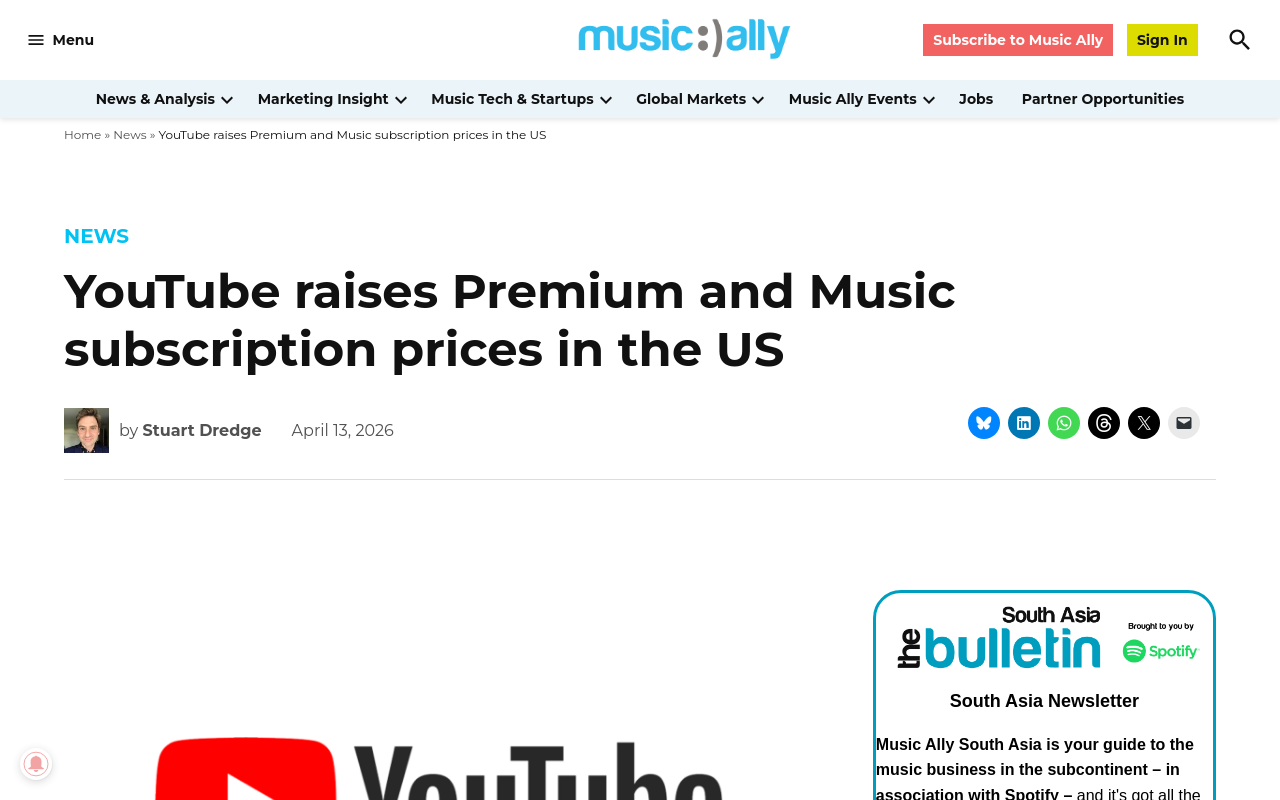
The receipt for YouTube Music's April 2026 US price rise, from the trade press
Source: https://musically.com/2026/04/13/youtube-raises-premium-and-music-subscription-prices-in-the-us/
YouTube's own pages could not be captured at all: every path on youtube.com and music.youtube.com refuses a server-side render with a content-security-policy error, and the YouTube Help article returns a blank frame. This is the coverage gap, stated up front. Prices for YouTube Music in this study therefore come from the trade press reporting the April 2026 increase, and from YouTube's own help documentation read as text, rather than from a captured pricing page. Spotify's prices are captured from Spotify's own page.
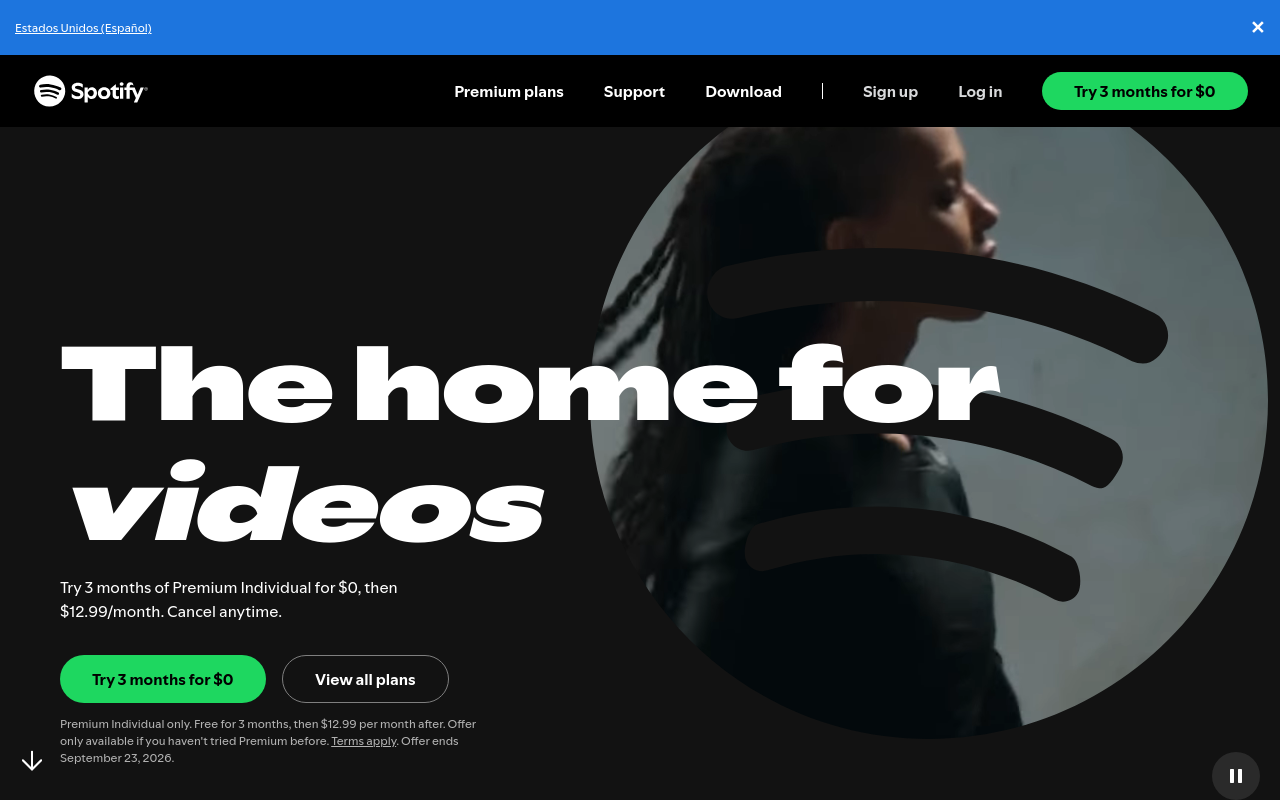
Spotify Premium, official US page, desktop
Source: https://www.spotify.com/us/premium/
The criteria, and how they were weighted
Set before capture, for the default buyer: one person in the US choosing a single music subscription. Nine rows, weights summing to 100.
| Criterion | Weight |
|---|---|
| Real price for your situation | 20 |
| Discovery and recommendations | 15 |
| Audio quality | 14 |
| Catalogue: official releases against everything ever uploaded | 13 |
| Free tier terms | 10 |
| What else the subscription includes | 10 |
| Devices and multi-device control | 8 |
| Library management and lock-in | 6 |
| Staying power in music | 4 |
The question that would most change these weights: do you already watch enough YouTube to want it ad-free? It reverses the price row completely, and it is the real decision hiding inside this comparison.
Spotify Premium
OFFICIAL (spotify.com/us/premium, captured 5 September 2026):
- Individual $12.99/month, Duo $18.99/month for 2, Family $21.99/month for up to 6, Student $6.99/month with Hulu
- "Free for 3 months, then $12.99 per month after," new subscribers only, "Offer ends September 23, 2026"
- Premium includes ad-free listening, lossless audio, offline downloads, and 15 hours a month of audiobooks
- A permanent free ad-supported tier
INDEPENDENT: about 31.7% of the global streaming market against YouTube Music's 10.3% (MIDiA via SQ Magazine, 2026). Lossless arrived late 2025 at up to 24-bit/44.1 kHz FLAC (HiFiWalker, 2026). Over 100 million tracks plus more than 7 million podcast titles.
WHO IT'S FOR: the listener who wants the best recommendations in the category, CD-quality audio at no extra cost, and music, podcasts and some audiobooks in one place. Also anyone who wants to use a music service seriously without paying, because Spotify's free tier permits background play and YouTube Music's does not.
YouTube Music Premium
OFFICIAL (youtube.com help documentation, read as text 5 September 2026, page could not be captured): "millions of songs, videos, and hard to find content like remixes, covers, and DJ sets without ads," offline downloads, and audio at "256 kbps when listening to music videos." No lossless tier is documented.
INDEPENDENT (prices, since YouTube's pricing page cannot be rendered): on 10 April 2026 YouTube raised US prices. Individual went from $10.99 to $11.99/month and family from $16.99 to $18.99/month, effective immediately for new subscribers and from the June billing cycle for existing ones (Music Ally, 13 April 2026; Digital Music News, 10 April 2026). Student is $5.99/month. The wider YouTube Premium bundle, which contains YouTube Music Premium in full plus ad-free and background YouTube video, is $15.99/month individual.
WHO IT'S FOR: the listener whose real library is on YouTube. Remixes, live sets, covers, radio edits, full concert uploads, the version with the intro, things that were never released commercially and exist nowhere else. And anyone who watches a lot of YouTube, for whom the music service is almost a rounding error on a subscription they want anyway.
The arithmetic that decides this comparison
YouTube Music alone is $11.99. YouTube Premium is $15.99 and contains it.
The marginal cost of YouTube Music, for someone who wants ad-free YouTube anyway, is $4.00 a month. Against Spotify's $12.99 that is not a price difference, it is a different category of decision. Conversely, for someone who does not care about YouTube video, YouTube Music at $11.99 is being asked to beat Spotify at $12.99 on a dollar, and a dollar does not buy the recommendation engine, the lossless audio, or the podcast and audiobook library.
So this comparison has a hinge rather than a winner, and the hinge is not about music at all.
Made with Cobalt Capture.
Open the live review for the export buttons (markdown, PDF, Word) and the share card.
Run this on your product
Connect the Cobalt server once, then ask for a comparison study of your own site. Replace the placeholder URL with yours.
-
Claude Code
/mcp__cobalt__comparison_study "Product A vs Product B" -
Codex
Run: curl -s https://cobaltcapture.com/playbooks/comparison-study.md Then follow it exactly for Product A vs Product B -
Cursor, VS Code, Claude chat, Perplexity
Compare Product A and Product B for me, with a Cobalt review
Claude Code runs it as a slash command once the server is connected. Codex has no slash commands: connect with codex mcp add cobalt --url https://cobaltcapture.com/mcp, then paste the two lines. Cursor and VS Code connect with the button above, then take the sentence. In Claude chat or Perplexity, add https://cobaltcapture.com/mcp as a connector and ask in plain words; this study reads public pages, so it runs in full there. What this study checks.
Connect your agent to Cobalt
Cursor and VS Code install in one click. Claude Code and Codex copy a command to run in your terminal, then restart the app.
Two music services a dollar apart on the sticker, except the real decision is not about music at all. This page carries the comparison study CobaltCapture ran cold against the makers' pages, published in full; the live review has the captures, sources, and export buttons.
Critical differences, most consequential first
- The bundle is the real question. Nothing else moves the numbers as far. Decide whether you want YouTube without ads first, then pick the music service, because that order gets the right answer and the other order does not.
- The free tiers are not comparable. Spotify free plays with the phone locked; YouTube Music free does not. For anyone using the free tier as more than a demo, that single behaviour settles it.
- Audio quality has separated. Level two years ago; Spotify shipped lossless in late 2025 and YouTube Music still documents 256 kbps.
- Catalogue depth runs the other way, and absolutely. If you want a live set or a mashup, one service has it and the other does not.
Where to start, if you are undecided
One question decides most of it: do you already watch enough YouTube to want it ad-free? If yes, YouTube Premium gives you the music for four dollars at the margin, and the comparison is over. If no, Spotify wins on everything except a single dollar and a catalogue of unreleased recordings, so the question becomes whether that catalogue is what you actually listen to.
Prices are what the makers showed on the run date. When either changes them, the study is re-run and this page moves to the new review, with the old one kept as history.
Frequently asked questions
Is Spotify or YouTube Music better?
For a US listener choosing one music subscription, Spotify leans clearly ahead, about 63 to 37 on this study's weights: better recommendations, lossless audio, one app for music and podcasts and audiobooks, and a free tier that works with the phone locked. YouTube Music wins on price and on catalogue depth. It flips to YouTube Music if you already want ad-free YouTube, or if the music you listen to is live sets, remixes, and covers that Spotify does not carry.
Is YouTube Music worth it if I have YouTube Premium?
That is the whole question, and usually yes. YouTube Music alone is $11.99 a month, but YouTube Premium is $15.99 and contains YouTube Music in full, plus ad-free and background YouTube video. So for someone buying ad-free YouTube anyway, the music service costs $4 a month at the margin. Against Spotify's $12.99, four dollars stops being a price difference and becomes the reason to choose it. Decide whether you want ad-free YouTube first, then pick the music service.
Does YouTube Music have lossless audio?
No, as of September 2026. YouTube's own documentation lists audio at 256 kbps and documents no lossless tier. Spotify shipped lossless in late 2025, up to 24-bit/44.1 kHz FLAC, which is CD quality. These two were level on sound quality two years ago; the gap now runs one way. If audio quality matters to you, it is a clear point for Spotify.
Which is cheaper, Spotify or YouTube Music?
YouTube Music, on the sticker: $11.99 a month against Spotify's $12.99 for one person, and $18.99 against $21.99 for a family of six, after YouTube's April 2026 US price rise. But the number that matters for many people is the bundle: YouTube Premium at $15.99 includes the music service, so if you want ad-free YouTube the music costs $4 at the margin. If you do not care about YouTube video, YouTube Music is trying to win on a single dollar, and a dollar does not buy Spotify's recommendations, lossless, or podcasts and audiobooks.
Which has the bigger music catalogue?
By count they are level, both past 100 million tracks. By kind they are not. YouTube Music includes remixes, covers, DJ sets, live uploads, and versions that were never released commercially and exist nowhere else, because it draws on everything uploaded to YouTube. If what you actually listen to is a 1994 live set or a mashup, YouTube Music has it and Spotify does not, and no amount of recommendation quality substitutes for the track being absent.
How was this run?
With CobaltCapture's comparison study, run by an AI agent on September 5, 2026. Nine criteria were weighted for a single-subscription listener before any capture. Spotify's US Premium page was captured as the receipt for its prices. YouTube's own pages could not be rendered at all (every path returned a content-security-policy error), so YouTube Music's prices come from the trade press reporting the 10 April 2026 US increase and its feature and audio claims from YouTube's help documentation read as text. That is a weaker evidentiary basis than Spotify's side, and the review says so plainly. It is not a claim that YouTube blocks AI assistants; only YouTube's own logs could show that.
Run your first study.
Give your AI assistant a URL and walk away. Come back to a shareable review with real screenshots and the verdict on top.
Run a study