
Spotify pricing, explained: every plan, and the trap in the couples plan
Spotify Premium is $12.99 a month for one person, $18.99 for two on Duo, $21.99 for up to six on Family, and $6.99 for a student, read from Spotify's own page on September 5, 2026. The one worth a second look is Duo: it is the plan named for couples at $18.99, and Family sits one row below it at $21.99, three dollars more for four extra accounts plus parental controls. The page never points that out.
Pricing teardown
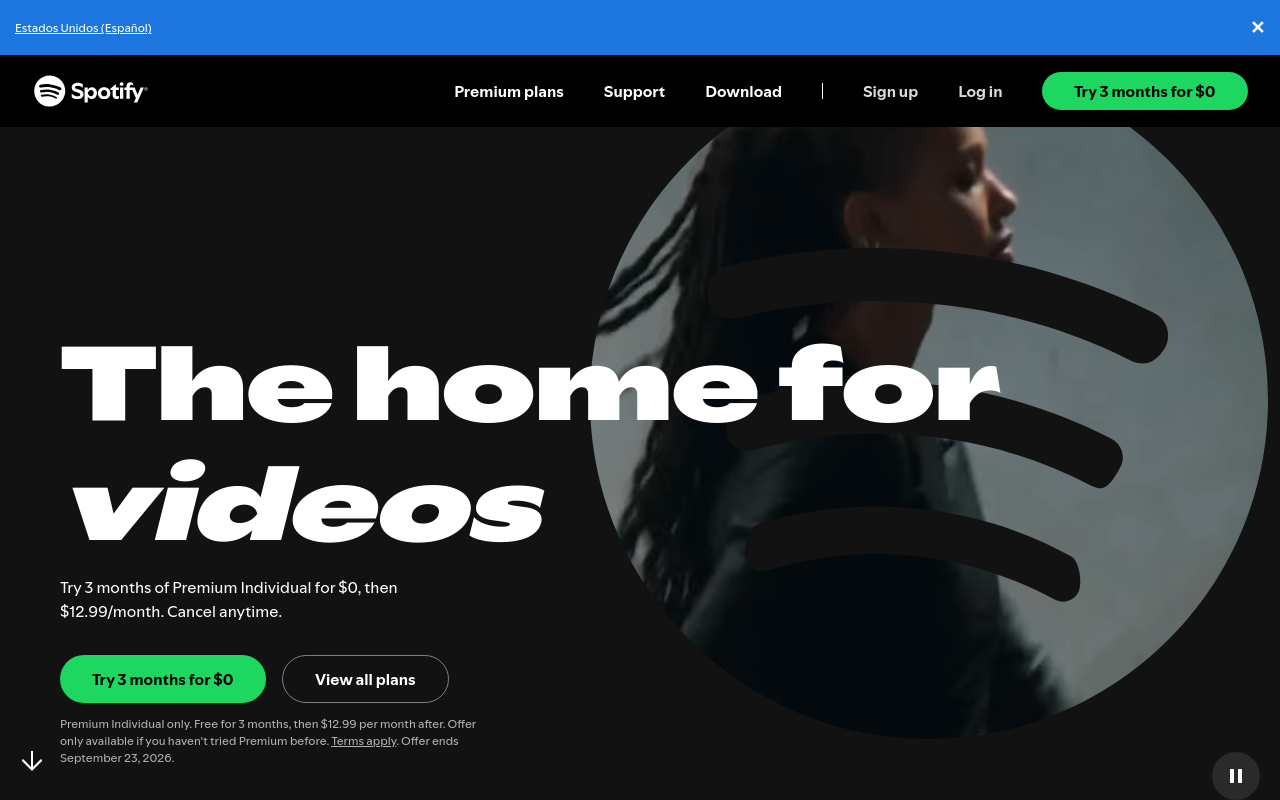
The page sells the offer, not the price. $0 is the largest thing on it, $12.99 is grey fine print, the headline is about video, and whether the price appears at the fold at all depends on which hero variant you are served.
What a buyer pays, as of Sep 5, 2026
| Buyer | Plan | Per month | First 12 months | Per head |
|---|---|---|---|---|
| One person | Individual | $12.99 | $116.91 | $12.99 |
| A couple | Duo | $18.99 | $227.88 | $9.50 |
| A family of four | Family | $21.99 | $263.88 | $5.50 |
| A student | Student | $6.99 | $76.89 | $6.99 |
What the study found
- Duo is beaten by Family for three dollars and the page never says so. Duo is $18.99 for two accounts; Family is $21.99 for up to six and adds parental controls and Premium for under-13s. The plan named for couples costs $18.99 for two accounts when $21.99 buys six. Three more dollars a month is four more accounts, so any household that might add a person, or just wants the room, is better off on Family.
- The offer is the headline and the price is the footnote. $0 is the largest and greenest element on the page. $12.99, the number a subscriber pays every month for years, appears at roughly a third of the size in grey.
- Whether the price is on the fold at all is a coin flip. Four renders of the same URL returned two different heroes, and on one phone render the price sentence was present above the buttons while on another it was absent entirely, leaving only Try 3 months for $0 with the price surviving in fine print.
- The audiobook allowance is per plan manager, presented as a plan feature. Premium includes 15 hours a month of audiobooks; on Duo and Family that allowance belongs to the plan manager alone. A family of six reading a features list will conclude they have six allowances.
- The pricing page for a music subscription is headlined The home for videos. A visitor arriving from a search for what Spotify costs has to work out that they are in the right place.
- The offer expires September 23, 2026, and the page says nothing about what comes after it. Anyone arriving on the 24th meets a page built entirely around an offer that has ended.

Read the full study
Spotify Premium pricing teardown
Published 2026-09-06 via Cobalt Capture.
Reviewing: https://www.spotify.com/us/premium/
Summary
The finding in one line: Spotify's pricing page sells the offer, not the price, and it is headlined "The home for videos." A visitor who arrives asking what Spotify costs meets a video pitch, a "$0" in the largest type on the page, and $12.99 in grey fine print underneath. Whether the price appears at the fold at all depends on which hero variant they are served, because the page is running at least two.
Run cold against the public page on 5 September 2026, US. No account, nothing submitted. Prices quoted as printed.
The price story the page transmits
In the buyer's words: "It's free for three months, and then it's about thirteen dollars, I think, and I should probably sign up before the twenty-third."
What is true: $12.99 a month for one person, $18.99 for two, $21.99 for up to six, $6.99 for a student, plus tax, with the first three months free only if you have never had Premium before.
The buyer math
| Buyer | Plan | Per month | First 12 months | Per head |
|---|---|---|---|---|
| One person | Individual | $12.99 | $116.91 | $12.99 |
| A couple | Duo | $18.99 | $227.88 | $9.50 |
| A family of four | Family | $21.99 | $263.88 | $5.50 |
| A student | Student | $6.99 | $76.89 | $6.99 |
Findings, worst first
MISLEADS
1. Duo is dominated by Family and the page never says so. Duo is $18.99 for two people. Family is $21.99 for six, and adds parental controls and Premium for under-13s. A couple who follows the page's own labelling to the plan named for couples pays $9.50 a head for something available at $3.67 a head one row down, for three dollars more a month. Direction: either price Duo below the point where Family dominates it, or show the per-person cost on every card so the comparison is visible.
2. The offer is the headline and the price is the footnote. "$0" is the largest and greenest thing on the page. $12.99, the number the buyer pays every month for years, appears at roughly a third of the size in grey. That is a deliberate emphasis and it inverts the importance of the two numbers. Direction: put the recurring price in the same sentence at the same weight, as the phone variant already does.
3. Whether the price is on the fold at all is a coin flip. Four renders of the same URL today returned two different heroes, "The home for videos" and "The ultimate home for videos", and on one phone render the price sentence was present above the buttons while on another it was absent entirely, leaving only "Try 3 months for $0" and fine print. A pricing page that sometimes states the price is not a pricing page. Direction: whatever else the hero test varies, hold the price line constant across variants.
4. The audiobook allowance is per plan manager, presented as a plan feature. Premium includes "15 hours/month audiobooks"; on Duo and Family that allowance belongs to the plan manager alone. A family of six reading a features list will conclude they have six allowances. They have one. Direction: state the restriction on the card, not in a footnote.
STALLS
5. The page for a music subscription is headlined "The home for videos." A visitor arriving from a search for Spotify's price has to work out that they are in the right place. Direction: the pricing page is a different job from the campaign; let it do that job.
6. No plans on the fold, on either width. A "View all plans" button, which concedes the point, and a page that scrolls inside an inner container, so the plan grid is a scroll away on desktop and a longer one on a phone.
7. The offer expires 23 September 2026, eighteen days after this capture, and the page says nothing about what comes after. Anyone arriving on the 24th sees a page built entirely around an offer that has ended.
FRICTION
8. Tax is never mentioned, so no price on the page is the price that will be charged.
9. A Spanish-language regional banner sits above the navigation on the US page on every render, pushing the whole page down before the buyer has read anything.
Keep list, the do-not-regress half
- The trial fine print is genuinely better than most. Duration, price afterwards, eligibility restriction, and a hard end date, all four, in one sentence directly under the button: "Premium Individual only. Free for 3 months, then $12.99 per month after. Offer only available if you haven't tried Premium before. Terms apply. Offer ends September 23, 2026." Most companies disclose one or two of those four. Keep all four.
- "Cancel anytime" sits at the fold, in the same sentence as the price.
- Plan names match their audiences and the eligibility rules are stated in plain words rather than implied: "For couples who reside at the same address."
- The phone layout communicates the number better than the desktop one in the variant that carries it, with the price directly beneath the headline in full-width type. That is the variant to standardise on.
- The free tier exists and is not hidden. For a company whose paid conversion depends on it, that is a real act of confidence.
Scope and method
Public page only, rendered and captured on 5 September 2026 at desktop and phone widths, four renders in total. Prices read from the page's own text. Coverage limit: the page scrolls inside an inner container, so a full-page capture returns the fold; the plan cards were read as text rather than captured in one image, and the toggles between plan views were not exercised, since this run does not drive the page.
The Premium page fold on desktop: a video headline, an offer, no plans
Source: https://www.spotify.com/us/premium/
The phone fold, which does the job the desktop fold does not: it states the price
Source: https://www.spotify.com/us/premium/
Pass A: the five-second fold
Desktop, spotify.com/us/premium. From the fold alone:
- How many plans and what are they called? Cannot answer. No plan list appears. There is a button reading "View all plans," which is an admission that the plans are not here.
- Which one is mine? Cannot answer.
- What does it cost? Partly. "Try 3 months of Premium Individual for $0, then $12.99/month. Cancel anytime." That is one plan's price, presented as the terms of an offer rather than as a price.
The headline above all of this reads "The home for videos." On the pricing page of a music subscription. A person arriving from a search for what Spotify costs meets a pitch for video.
The fold is not stable. Across four renders of the same URL today the page served two different heroes: "The home for videos" and "The ultimate home for videos". On one phone render the price sentence was present above the buttons; on another it was absent, leaving only "Try 3 months for $0" with $12.99 surviving in grey fine print beneath. Whether a visitor sees the price at the fold depends on which variant they are served.
Phone, in the variant that carries it, is better than desktop. The price sentence sits directly under the headline in full-width type. That is worth saying plainly because it is rare: the phone layout communicates the number more clearly than the desktop one.
Pass B: the buyer math
Prices as printed, captured 5 September 2026.
| Buyer | Plan the page steers them to | Per month | First 12 months | Per head |
|---|---|---|---|---|
| One person | Premium Individual | $12.99 | $116.91 (3 months free, then 9 × $12.99) | $12.99 |
| A couple | Premium Duo | $18.99 | $227.88 | $9.50 |
| A family of four | Premium Family | $21.99 | $263.88 | $5.50 |
| A student | Premium Student | $6.99 | $76.89 (1 month free) | $6.99 |
Then look at the two middle rows together. Duo costs $18.99 for two people. Family costs $21.99 for six. Three dollars a month more than the couples plan buys four more accounts, parental controls, and Premium for under-13s. A couple who follows the page's own labelling to the plan named for couples pays $9.50 a head for something priced at $3.67 a head one row away. Nothing on the page notes this.
Pass C: tier architecture
The ladder is otherwise clean: one account, two, six, or a student. Names match audiences, the eligibility rules are stated rather than implied ("For couples who reside at the same address", "For up to 6 family members residing at the same address"), and there is no contact-sales fog because there is no enterprise tier to hide.
Two things undercut it:
- Duo is dominated by Family, above.
- The audiobook entitlement is per plan manager, not per person. Premium includes "15 hours/month audiobooks", and on Duo and Family that allowance belongs to the plan manager alone. A family of six reading that line will reasonably conclude they have six allowances. They have one.
Pass D and E: fine print and trust
The trial fine print is, genuinely, better than most: it states the duration, the price afterwards, the eligibility restriction, and a hard end date, all four, in one sentence directly beneath the button. "Premium Individual only. Free for 3 months, then $12.99 per month after. Offer only available if you haven't tried Premium before. Terms apply. Offer ends September 23, 2026." Most companies disclose one or two of those four. Spotify discloses all four.
What works against it:
- The offer is the headline and the price is the footnote. The largest green element on the page says "$0". The number the buyer will actually pay every month for years appears at roughly a third of that size.
- The offer expires 18 days after this capture and the page says nothing about what a visitor arriving on 24 September is being offered.
- Tax is never mentioned.
- A Spanish-language regional banner sits across the top of the US page on every render, above the navigation, pushing everything down. It is a locale prompt on a page whose job is to sell.
Pass F: phone
Covered in Pass A. The plan cards are below the fold on both widths, and the page scrolls inside an inner container, so a full-page capture returns the fold only. The plan grid was read from the page's own text rather than captured as one image, and that limitation is stated in the summary.
Made with Cobalt Capture.
Open the live review for the export buttons (markdown, PDF, Word) and the share card.
Run this on your product
Connect the Cobalt server once, then ask for a pricing teardown of your own site. Replace the placeholder URL with yours.
-
Claude Code
/mcp__cobalt__pricing_teardown https://your-product.com -
Codex
Run: curl -s https://cobaltcapture.com/playbooks/pricing-teardown.md Then follow it exactly against https://your-product.com -
Cursor, VS Code, Claude chat, Perplexity
Run a pricing teardown of https://your-product.com
Claude Code runs it as a slash command once the server is connected. Codex has no slash commands: connect with codex mcp add cobalt --url https://cobaltcapture.com/mcp, then paste the two lines. Cursor and VS Code connect with the button above, then take the sentence. In Claude chat or Perplexity, add https://cobaltcapture.com/mcp as a connector and ask in plain words; this study reads public pages, so it runs in full there. What this study checks.
Connect your agent to Cobalt
Cursor and VS Code install in one click. Claude Code and Codex copy a command to run in your terminal, then restart the app.
Spotify's prices are simple. Its pricing page is not, mostly because it is built to sell a three-month offer rather than to answer the question people arrive with. This page carries the pricing teardown run cold against that page, published in full with the captures.
If you only want the numbers: $12.99 for one, $18.99 for two, $21.99 for six, $6.99 for a student. And if you are two people, look hard at the six-person plan before you pick the two-person one.
Prices are what spotify.com showed on the run date at the top of the section above. When Spotify changes them, the study is re-run and this page moves to the new review, with the old one kept as history.
Frequently asked questions
How much is Spotify Premium?
As of September 5, 2026, in the United States: Premium Individual is $12.99 a month for one account, Premium Duo is $18.99 a month for two accounts at the same address, Premium Family is $21.99 a month for up to six accounts at the same address, and Premium Student is $6.99 a month with Hulu included. New subscribers who have never had Premium before get three months free on Individual, an offer the page states ends September 23, 2026. Tax is not mentioned anywhere on the page.
Is Spotify Duo or Family better value?
Family, and the gap is only three dollars a month. Duo is $18.99 for two accounts; Family is $21.99 for up to six, and adds parental controls and Premium for members under 13. Three dollars more buys four extra accounts, so anyone beyond a fixed pair of two, or a couple who might add a family member later, is better off on Family. Both require members to live at the same address, so the eligibility rule is identical. Spotify presents Duo as the plan for couples and never mentions that Family costs barely more.
Is Spotify Premium worth it?
This study judged the pricing page rather than the product, so the honest answer depends on what you would use. Two things are worth knowing before deciding. The first is that Spotify's free tier permits background play on a phone, so unlike some rivals it is genuinely usable without paying, which makes the three free months a low-risk way to find out. The second is that Premium now includes lossless audio and 15 hours a month of audiobooks, and the audiobook allowance belongs to the plan manager alone on Duo and Family, which is not obvious from the features list.
How long is the Spotify free trial and what happens after?
Three months free on Premium Individual, then $12.99 a month, available only to people who have never tried Premium before. Spotify's fine print states the duration, the price afterwards, the eligibility restriction, and a hard end date of September 23, 2026, all in one sentence directly under the button. That is more complete disclosure than most companies give, and it is the strongest thing on the page.
Does Spotify have a free plan?
Yes, a permanent ad-supported tier that sits alongside the paid plans and is not hidden. The practical difference from some rivals is that Spotify's free tier plays with the phone locked, so it works as an everyday music service rather than a demonstration. Premium removes the advertising and adds lossless audio, offline downloads, full playback control, and the audiobook allowance.
How was this run?
With CobaltCapture's pricing teardown playbook, run by an AI agent against spotify.com's public US Premium page on September 5, 2026, with no account created and nothing submitted. The page was rendered four times at desktop and phone widths, which is how the varying hero was found. The page scrolls inside an inner container, so a full-page capture returns the fold only; the plan cards were read from the page's own text rather than captured as a single image, and this is stated in the review.
Run your first study.
Give your AI assistant a URL and walk away. Come back to a shareable review with real screenshots and the verdict on top.
Run a study