
Shopify pricing, explained: what you pay, and when upgrading is worth it
Shopify is $29 a month for Basic, $79 for Grow and $299 for Advanced on annual billing, or $39, $105 and $399 if you pay monthly, plus 2.9% and 30 cents on every card payment. Read on September 6, 2026 from Shopify's own page. The finding that drove this study is that the plans are sold on features but priced on card-rate savings, so each upgrade has a sales figure above which it pays for itself: Grow at about $25,000 a month and Advanced at about $110,000. Neither number appears anywhere on the page.
Pricing teardown
The plans are sold on features and priced on card-rate savings. Grow only pays for itself above about $25,000 a month in sales, Advanced above about $110,000, and neither number is on the page.
What a buyer pays, as of Sep 6, 2026
| Buyer | Plan | Subscription | Card fees | Total per month | Subscription as a share |
|---|---|---|---|---|---|
| Solo, $2,000/mo sales | Basic yearly | $29 | $70 | $99 | 29% |
| Store, $10,000/mo | Basic yearly | $29 | $350 | $379 | 8% |
| Same store on Grow | Grow yearly | $79 | $330 | $409 | costs $30 more |
| Store, $50,000/mo | Grow yearly | $79 | $1,650 | $1,729 | 5% |
| Same store on Advanced | Advanced yearly | $299 | $1,550 | $1,849 | costs $120 more |
What the study found
- The upgrade break-evens are computable and hidden. Each step up buys 0.2 percent off the card rate. Grow costs $50 a month more than Basic, so it pays for itself at $50 divided by 0.002, which is $25,000 a month in sales. Advanced costs $220 more than Grow, so it pays at $110,000. Below those figures the cheaper plan is strictly better, and the page steers by audience label instead.
- The billing toggle is pre-set to the cheaper state and the cards do not say so. Pay yearly is on by default, so the headline $29, $79 and $299 are annual-commitment prices. Monthly is $39, $105 and $399, between 33 and 34 percent higher.
- The third-party transaction fee changes the answer five-fold and is never explained on the cards. The 2 percent, 1 percent and 0.6 percent figures apply only if you do not use Shopify Payments. On an outside gateway the Basic to Grow gap is 1 percent rather than 0.2, which moves the break-even from $25,000 down to about $5,000 a month.
- Basic includes zero staff accounts, and the card does not mention it. The space is used for Built-in AI assistant and Millions of tokens instead. A two-person business hits this on the first day.
- Millions of tokens is a limit written as an adjective. No unit, no overage price, no way to judge whether it covers your catalogue. Earn up to $5,000 in credits sits behind an information icon on every tier at a different number.
- At 1280 pixels the fourth card is clipped mid-word. Plus renders as fron and 2.25% plus, so the top of the ladder is cut off at a very common desktop width.

Read the full study
Shopify pricing teardown
Published 2026-09-07 via Cobalt Capture.
Reviewing: https://www.shopify.com/pricing
Summary
The finding in one line: Shopify's plans are sold on features and priced on card-rate savings, and the two numbers that actually decide your plan are never on the page. Grow only pays for itself above about $25,000 a month in sales. Advanced only pays for itself above about $110,000 a month. Both take one division to work out from figures Shopify prints, and a merchant doing $10,000 a month who upgrades to Grow because "for small teams" describes them is paying $30 a month extra for a description.
Run cold against the public pricing page on 6 September 2026, US. No account, nothing submitted. Prices quoted as printed.
The price story the page transmits
In the buyer's words: "It's twenty-nine dollars a month to start, three days free, and a dollar a month for the first three months."
What is true: $29 a month only if you commit to a year, $39 if you do not, plus 2.9% and 30 cents on every card payment, plus a further 2% if you take payment through anyone but Shopify, plus tax. For most merchants the subscription is the smallest line on that list.
The buyer math
| Buyer | Plan | Subscription | Card fees | Total per month | Subscription as a share |
|---|---|---|---|---|---|
| Solo, $2,000/mo sales | Basic yearly | $29 | $70 | $99 | 29% |
| Store, $10,000/mo | Basic yearly | $29 | $350 | $379 | 8% |
| Same store on Grow | Grow yearly | $79 | $330 | $409 | costs $30 more |
| Store, $50,000/mo | Grow yearly | $79 | $1,650 | $1,729 | 5% |
| Same store on Advanced | Advanced yearly | $299 | $1,550 | $1,849 | costs $120 more |
Findings, worst first
MISLEADS
1. The upgrade crossover points are computable and hidden. Each step up the ladder buys 0.2% off the card rate. Grow costs $50 a month more than Basic, so it pays for itself at $50 divided by 0.002, which is $25,000 a month in sales. Advanced costs $220 more than Grow, so it pays at $110,000 a month. Below those numbers the cheaper plan is strictly better and the page steers by audience label instead. Direction: print the crossover on each card. "Worth it above $25,000/mo in sales" is one line and would be the most useful sentence on the page.
2. The billing toggle is pre-set to the cheaper state, and the cards do not say so. "Pay yearly" is on by default, so the headline $29, $79 and $299 are annual-commitment prices. Monthly is $39, $105 and $399, between 33% and 34% higher. A visitor who is not ready to commit to a year is reading numbers that do not apply to them. Direction: show both numbers on the card, as the plan comparison further down already does.
3. The third-party transaction fee changes the answer five-fold and is never explained on the cards. The 2%, 1% and 0.6% figures apply only if you do not use Shopify Payments. On an outside gateway the Basic-to-Grow gap is 1% rather than 0.2%, which moves the crossover from $25,000 down to about $5,000 a month. Same two plans, same page, completely different advice, resting on a distinction a first-time merchant will not know to make. Direction: label the fee as what it is, the cost of not using Shopify Payments.
4. Basic includes zero staff accounts, and the card does not mention it. The Basic card lists "Built-in AI assistant" and "Millions of tokens" in that space instead. A two-person business hits this on the first day. Direction: absence of a staff account is a limit and belongs on the card.
STALLS
5. "Millions of tokens" is a limit written as an adjective. No unit, no overage price, no way to judge whether it covers your catalogue.
6. "Earn up to $5,000 in credits" is behind an information icon. "Up to", plus a tooltip, is not a disclosed benefit, and it appears on every tier at a different number as though it were one.
7. Card rates are quoted "from". The rate a given merchant actually gets is not committed to anywhere on the page, which makes the buyer math above a best case.
FRICTION
8. The introductory offer defers the real price by three months. "Try 3 days free, then $1/month for 3 months" means the first real invoice lands in month four, long after the decision.
9. At 1280px the fourth card is clipped mid-word. Plus renders as "fron..." and "2.25% + ...", so the top of the ladder is cut off at a very common desktop width.
Keep list, the do-not-regress half
- Every plan card shows its card processing rate, on the card. Most ecommerce platforms bury this. Showing it in the grid is the single best thing about this page, and it is what makes the crossover arithmetic possible at all.
- Each tier names its audience directly under the plan name. "For solo entrepreneurs", "For small teams", "For global reach", "For complex businesses". A visitor can find their row in about two seconds.
- Plus publishes a starting price of $2,300 a month rather than hiding behind "contact sales". At that end of a ladder this is rare and it is the honest choice.
- "Compare all features" sits at the top of the grid, not buried under it.
- The transaction fee is disclosed at all. Several competitors do not put it on the pricing page in any form.
Scope and method
Public page only, rendered and captured on 6 September 2026 at the fold and full page. Prices, card rates, transaction fees and staff-account counts read from the page's own text, both billing states. Buyer math assumes Shopify Payments and an average order value near $50; different order values move the 30-cent component but not the crossover points, which depend only on the percentage gap.
Coverage gap: the phone view is not covered. Two attempts to render at 390 pixels returned an unstyled document with no CSS, so no phone finding appears here. That is a limitation of this run, not a claim about Shopify's mobile site.
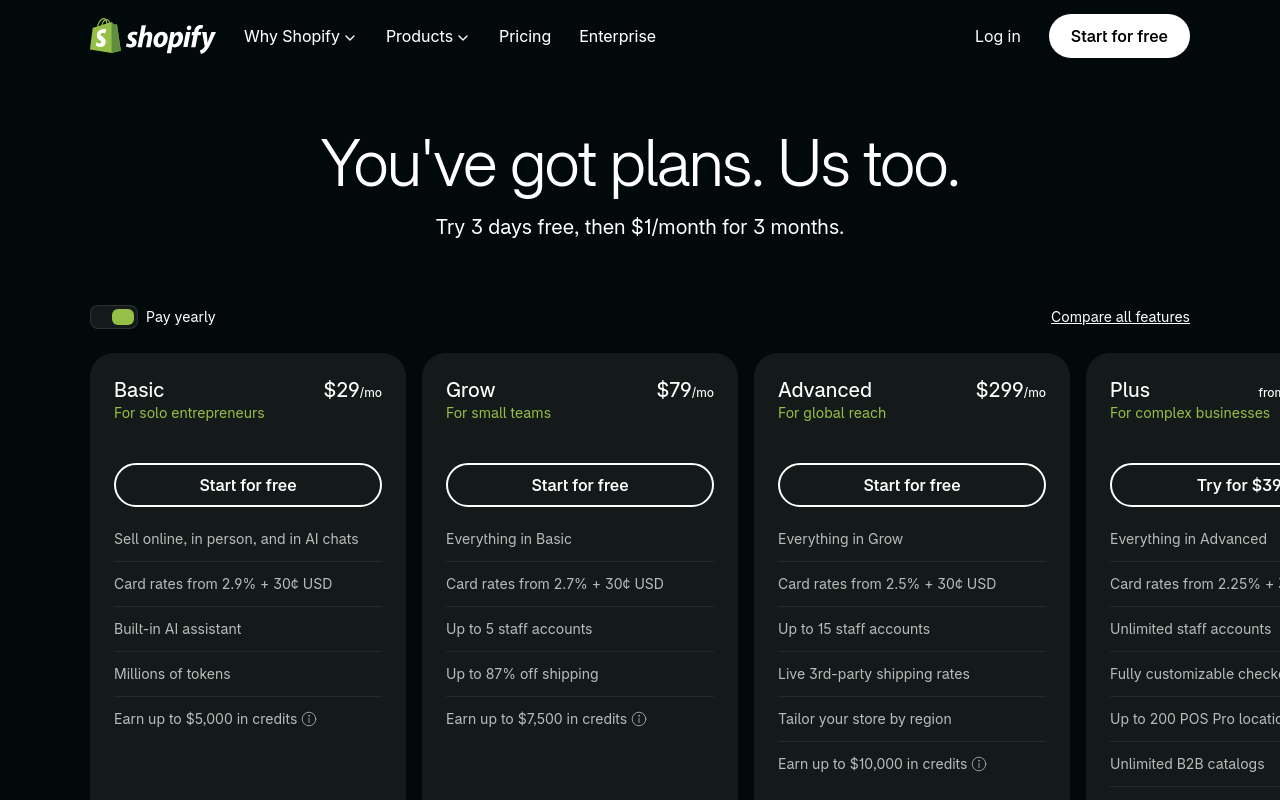
Shopify pricing, desktop fold, default state
Source: https://www.shopify.com/pricing
The page below the fold, where the fees and the fine print live
Source: https://www.shopify.com/pricing
Phone coverage gap, stated up front: two attempts to render this page at 390px returned an unstyled document with no CSS, so the phone fold could not be judged and no phone finding appears in this study. That is a limit of this run, not a claim about Shopify's mobile site, which works normally in an ordinary phone browser.
Pass A: the five-second fold
Desktop, default state. From the fold alone:
- How many plans and what are they called? Four: Basic, Grow, Advanced, Plus. Clear.
- Which is mine? Answerable, and this is the page's best feature. Each card carries an audience line directly under the name: "For solo entrepreneurs", "For small teams", "For global reach", "For complex businesses".
- What does it cost? $29, $79, $299 a month, and Plus from $2,300. Except those are not the prices most buyers will pay, for the reason below.
The toggle is pre-set to the cheaper state. "Pay yearly" is switched on by default, so every headline number is the annual-commitment price. Pay monthly and Basic is $39, Grow $105, Advanced $399. The buyer scanning the fold is reading prices that are 34%, 33% and 34% below what they will pay if they are not ready to commit to a year, and nothing in the card says so.
At 1280px the fourth card is clipped mid-word. "Plus" shows as "fron..." and "2.25% + ...", so the most expensive plan is cut off at one of the most common desktop widths.
Pass B: the buyer math, and the thing the page never tells you
An ecommerce buyer does not price themselves by seat count, so the three buyers here are three store sizes. Card rates assume Shopify Payments and an average order around $50.
| Plan | Yearly | Monthly | Staff | Card rate | Third-party fee |
|---|---|---|---|---|---|
| Basic | $29 | $39 | 0 | 2.9% + 30¢ | 2% |
| Grow | $79 | $105 | 5 | 2.7% + 30¢ | 1% |
| Advanced | $299 | $399 | 15 | 2.5% + 30¢ | 0.6% |
| Plus | from $2,300 | Unlimited | most competitive | 0.2% |
Buyer 1, a solo seller doing $2,000 a month, about 40 orders. Basic at $29, plus 2.9% of $2,000 which is $58, plus 40 times 30 cents which is $12. About $99 a month, of which the subscription is 29%.
Buyer 2, a store doing $10,000 a month, about 200 orders. On Basic: $29 + $290 + $60 = $379. On Grow: $79 + $270 + $60 = $409. Grow is the more expensive choice at this size. The subscription is now under 8% of what this merchant pays Shopify.
Buyer 3, a store doing $50,000 a month, about 1,000 orders. On Grow: $79 + $1,350 + $300 = $1,729. On Advanced: $299 + $1,250 + $300 = $1,849. Advanced is still the worse deal.
Which produces the finding this whole study is about. The tiers are sold on features but priced on card-rate savings, and the crossover points are computable and never shown:
- Grow only pays for itself above about $25,000 a month in sales. The extra $50 a month buys 0.2% off the card rate, and $50 divided by 0.002 is $25,000. On monthly billing the crossover is about $33,000.
- Advanced only pays for itself above about $110,000 a month. The extra $220 buys another 0.2%. On monthly billing, about $147,000.
Those two numbers decide the plan for almost every merchant on this page, they take one division to compute, and neither appears anywhere on it. A buyer choosing Grow because "for small teams" describes them, at $10,000 a month in sales, is paying $30 a month for a description.
The one thing that changes this arithmetic is the third-party transaction fee, which is a separate axis the cards do not explain. The 2%, 1% and 0.6% figures apply only if you do not use Shopify Payments. A merchant on an outside gateway sees a 1% gap between Basic and Grow rather than 0.2%, which moves the crossover from $25,000 down to about $5,000 a month. Same page, same two plans, a five-fold difference in the answer, resting on a distinction the cards never draw.
Pass C and D: tier architecture, limits, fine print
- Basic includes zero staff accounts. The fold's Basic card lists "Built-in AI assistant" and "Millions of tokens" instead. A two-person shop hits this on day one and it is not on the card.
- "Millions of tokens" is a limit expressed as an adjective. No unit, no overage price, no way to know whether that is a lot for your store.
- "Earn up to $5,000 in credits" sits behind an information icon on Basic, rising to $7,500 and $10,000. "Up to" plus an icon is not a disclosed benefit.
- Card rates are quoted "from". The actual rate a given merchant gets is not guaranteed by the page.
- The introductory offer defers the real price by three months. "Try 3 days free, then $1/month for 3 months." A merchant signing up in September first pays a real invoice in January.
Pass E and F: trust, and the phone gap
Trust at the ask is better than most. Every card shows its card processing rate, on the card, which is unusual and genuinely useful. Plus shows a starting number, $2,300, rather than "contact sales", which is rarer still at that end of a ladder. "Compare all features" sits at the top of the grid rather than buried.
Phone: not covered. Two attempts to render this page at 390 pixels returned an unstyled document with no CSS. The phone fold could not be judged and no phone finding appears in this study. That is a limitation of this run, not a claim about Shopify's mobile site.
Made with Cobalt Capture.
Open the live review for the export buttons (markdown, PDF, Word) and the share card.
Run this on your product
Connect the Cobalt server once, then ask for a pricing teardown of your own site. Replace the placeholder URL with yours.
-
Claude Code
/mcp__cobalt__pricing_teardown https://your-product.com -
Codex
Run: curl -s https://cobaltcapture.com/playbooks/pricing-teardown.md Then follow it exactly against https://your-product.com -
Cursor, VS Code, Claude chat, Perplexity
Run a pricing teardown of https://your-product.com
Claude Code runs it as a slash command once the server is connected. Codex has no slash commands: connect with codex mcp add cobalt --url https://cobaltcapture.com/mcp, then paste the two lines. Cursor and VS Code connect with the button above, then take the sentence. In Claude chat or Perplexity, add https://cobaltcapture.com/mcp as a connector and ask in plain words; this study reads public pages, so it runs in full there. What this study checks.
Connect your agent to Cobalt
Cursor and VS Code install in one click. Claude Code and Codex copy a command to run in your terminal, then restart the app.
Shopify publishes more of its real economics than most of the category. Every plan card shows its card processing rate, which is unusual and genuinely useful. What it does not do is the one piece of arithmetic those numbers make possible, which is the arithmetic that decides your plan.
If you only want the answer: stay on Basic until about $25,000 a month in sales, then Grow, then Advanced at about $110,000. Unless you use a payment gateway other than Shopify Payments, in which case move to Grow at about $5,000.
Prices are what shopify.com showed on the run date at the top of the section above. When Shopify changes them, the study is re-run and this page moves to the new review.
Frequently asked questions
How much does Shopify cost per month?
As of September 6, 2026 in the United States: Basic is $29 a month, Grow is $79 and Advanced is $299, all on annual billing. Paying monthly instead costs $39, $105 and $399, between 33 and 34 percent more. Shopify Plus starts at $2,300 a month. Every plan also charges card processing from 2.9 percent plus 30 cents on Basic, falling to 2.5 percent on Advanced, and a further transaction fee of 2 percent, 1 percent or 0.6 percent if you take payment through a gateway other than Shopify Payments.
Is Shopify Basic enough, or should I upgrade to Grow?
Stay on Basic until you are selling roughly $25,000 a month. The only material difference in cost between the two plans is 0.2 percent off the card rate, and Grow costs $50 a month more, so $50 divided by 0.002 gives a break-even of $25,000 in monthly sales. Below that, Grow costs you money. There are two exceptions: Basic includes no staff accounts at all, so a second person forces the upgrade regardless, and if you use a payment gateway other than Shopify Payments the gap is 1 percent rather than 0.2 percent, which drops the break-even to about $5,000 a month.
When is Shopify Advanced worth it?
At roughly $110,000 a month in sales, on Shopify Payments. Advanced costs $220 a month more than Grow and buys another 0.2 percent off the card rate, so $220 divided by 0.002 is $110,000. On monthly billing the figure is nearer $147,000. Below that, Grow is cheaper in total even though Advanced has the lower headline card rate, which is the single most common way merchants overpay on this page.
What is the real cost of running a Shopify store?
For most merchants the subscription is the smallest line. A store doing $10,000 a month over 200 orders pays $29 for Basic plus about $350 in card fees, so the plan is under 8 percent of what it pays Shopify. A solo seller doing $2,000 a month pays about $99 in total, of which $29 is the subscription. Judge the plans on their card rates and transaction fees rather than the monthly price, because that is where nearly all the money goes.
Does Shopify have a free trial?
Three days free, then $1 a month for three months, as printed on the pricing page. That means the first invoice at the real price arrives in month four, well after the decision to build a store has been made. Nothing on the page says what the price becomes at that point, so work from the plan prices above rather than the introductory offer.
How was this run?
With CobaltCapture's pricing teardown playbook, run by an AI agent against shopify.com's public pricing page on September 6, 2026, with no account created and nothing submitted. Prices, card rates, transaction fees and staff-account counts were read from the page's own text in both billing states. The buyer math assumes Shopify Payments and an average order value near $50; different order values move the 30-cent component but not the break-even points, which depend only on the percentage gaps. One coverage gap: the page returned an unstyled document to the mobile renderer on two attempts, so the phone view is not covered.
Run your first study.
Give your AI assistant a URL and walk away. Come back to a shareable review with real screenshots and the verdict on top.
Run a study