
Rolex vs Omega: the Oyster Perpetual 36 against the Aqua Terra 38
Compared as a first everyday luxury watch, US market, official pages captured 5 September 2026. The lean is the Omega Aqua Terra 38, clear: it costs $1,000 to $1,500 less this month (it sells below its $7,100 list while the Rolex sells above its $6,750 list, or at list only after a wait), you can buy it this week, and it has a date. It flips to the Rolex if you expect to sell or trade up within a few years, or if you do not want a date and can wait weeks for a Rolex at list price.
Rolex Oyster Perpetual 36
Ref. 126000
- List
- $6,750
- Street
- about $7,500 (standard dials); $15,000 and up (bright dials)
Omega Seamaster Aqua Terra 150M 38 mm
Ref. 220.10.38.20.03.001
- List
- $7,100
- Street
- about $5,900 to $6,400
· Compared for: A first everyday luxury watch, $6,000 to $7,500, US market
The lean
Omega Seamaster Aqua Terra 150M 38 mm, clear (60 to 40 on the approved weights).
- Real price today: the Omega sells below list at about $5,900 to $6,400; the Rolex sells above list at about $7,500, or at $6,750 only after a wait
- Availability: in stock this week, against dealer allocation of weeks to months
- The date: the Omega has one, the Rolex does not
What would flip it
- You expect to sell or trade up within a few years. The Oyster Perpetual roughly holds its value and the Aqua Terra loses a meaningful share, which moves the lean to a slight Rolex.
- You do not want a date and can wait weeks for a Rolex at list. The price gap shrinks to about $400 to $800, and the Rolex's bracelet, thinner case, and anonymity carry it to a slight Rolex.
- It has to be a Rolex. Then buy the Oyster Perpetual 36 in a standard dial and skip the bright ones, which double the price and the wait.
The matrix
| Criterion | Rolex OP36 | Omega AT38 | Edge |
|---|---|---|---|
| Real price today [20] | List $6,750 at a dealer after a wait; grey market about $7,500 for standard dials, $15,000 and up for bright dials | List $7,100; new examples about $5,900 to $6,400 at dealers, discounts common | Omega, by about $1,000 to $1,500 this week |
| Availability, how you buy [15] | Dealer allocation; standard dials weeks to a few months; no numbered list | In stock at dealers and boutiques now; Omega's own site showed unavailable online, join the wish list, at capture | Omega, decisively |
| Resale [15] | Standard dials roughly hold; bright dials have gained | Loses a meaningful share on the secondary market | Rolex, clear |
| Date [10] | None | Yes, at 6 o'clock | Omega (it has one) |
| Bracelet and clasp [10] | Oyster bracelet, Easylink 5 mm on-the-fly extension | Steel bracelet, butterfly clasp, no on-the-fly adjustment | Rolex, clear |
| Movement [10] | Cal. 3230, 70 h reserve, -2/+2 s a day after casing, solid caseback | Cal. 8800, 55 h reserve, METAS 0/+5 s a day after casing, 15,000 gauss anti-magnetic, sapphire caseback | Omega, slight: anti-magnetism and a visible movement outweigh 15 hours of reserve |
| Size and wearability [8] | 36 mm, about 11.5 mm thick, about 43.5 mm lug to lug | 38 mm, 12.24 mm thick, 45.0 mm lug to lug | Rolex, slight: thinner and more compact; a try-on question |
| Discretion, brand signal [7] | In a dark dial, about as anonymous as a luxury watch gets | Recognisable to enthusiasts, invisible to everyone else | Rolex, slight |
| Water resistance [5] | 100 m | 150 m | Omega, modest; neither is a dive watch |
Not separating factors
Things people weigh that do not decide this one, so you can stop weighing them:
- Steel grade (904L versus 316L)
- Finishing quality
- Real-world accuracy: both are chronometer-grade after casing and owners report similar results
- Five-year warranty (both)
- Sapphire crystal and screw-down crown (both)
- Ownership cost: Rolex service about $800 to $1,000 roughly every 10 years, Omega about $650 to $800 every 5 to 8 years, a wash over twenty years
Read the full comparison
Rolex Oyster Perpetual 36 vs Omega Aqua Terra 38: everyday luxury watches compared
Published 2026-09-06 via Cobalt Capture.
Reviewing: https://www.rolex.com/en-us/watches/oyster-perpetual/m126000-0006
Summary
Rolex Oyster Perpetual 36 vs Omega Aqua Terra 38: everyday luxury watches compared
The short version. For a first everyday luxury watch bought this month, the lean is the Omega Aqua Terra 38, clear (about 60 to 40 on the approved weights). It costs less today, you can buy it this week, and it has a date. The three rows that drive it: real price (the Omega sells below its list price while the Rolex sells above list, or at list only after a wait), availability (in stock versus dealer allocation), and the date window.
What would flip it. Two situations reverse the lean, and each is common: 1. You expect to sell or trade up within a few years. Resale is the Rolex's decisive row; the Oyster Perpetual roughly holds its value and the Aqua Terra loses a meaningful share. Weight that heavily and the lean moves to a slight Rolex. 2. You do not want a date and you can wait weeks for a Rolex at list. The price gap shrinks to about $400 to $800, the date row goes quiet, and the Rolex's bracelet, thinner case, and anonymity carry it to a slight Rolex lean. If it has to be a Rolex, none of this matters: buy the Oyster Perpetual 36 in a standard dial and skip the bright ones.
The matrix. Official figures from rolex.com and omegawatches.com US pages captured 5 September 2026; market figures are a September 2026 snapshot from dealer listings, shown as ranges, not quotes. Weights in brackets are the approved buyer weights.
| Row | Rolex Oyster Perpetual 36 (126000) | Omega Aqua Terra 38 (220.10.38.20.03.001) | Edge |
|---|---|---|---|
| Real price today [20] | List $6,750 at a dealer after a wait; grey market about $7,500 for standard dials, $15,000 and up for bright dials | List $7,100; new examples about $5,900 to $6,400 at dealers, discounts common | Omega, by about $1,000 to $1,500 this week |
| Availability, how you buy [15] | Dealer allocation; standard dials weeks to a few months; no numbered list | In stock at dealers and boutiques now; Omega's own site showed "unavailable online, join the wish list" for this reference at capture | Omega, decisively |
| Resale [15] | Standard dials roughly hold; bright dials have gained | Loses a meaningful share on the secondary market | Rolex, clear |
| Date [10] | None | Yes, at 6 o'clock | Omega (it has one) |
| Bracelet and clasp [10] | Oyster bracelet, Easylink 5 mm on-the-fly extension | Steel bracelet, butterfly clasp, no on-the-fly adjustment | Rolex, clear |
| Movement [10] | Cal. 3230, 70 h reserve, -2/+2 s a day after casing, solid caseback | Cal. 8800, 55 h reserve, METAS 0/+5 s a day after casing, 15,000 gauss anti-magnetic, sapphire caseback | Omega, slight: anti-magnetism and a visible movement outweigh 15 hours of reserve |
| Size and wearability [8] | 36 mm, about 11.5 mm thick, about 43.5 mm lug to lug | 38 mm, 12.24 mm thick, 45.0 mm lug to lug | Rolex, slight: thinner and more compact; a try-on question |
| Discretion, brand signal [7] | In a dark dial, about as anonymous as a luxury watch gets | Recognisable to enthusiasts, invisible to everyone else | Rolex, slight |
| Water resistance [5] | 100 m | 150 m | Omega, modest; neither is a dive watch |
Weighted total: Omega 60, Rolex 40.
Critical differences, most consequential first: 1. What you pay and when you get it inverts the sticker prices. Retail says the Rolex is $350 cheaper. This month the Omega is the cheaper watch by $1,000 to $1,500 and it is in the case; the Rolex costs more than list to buy today, or list after a wait. 2. Date or no date. Binary. Anyone who reads the date off their wrist has eliminated the Oyster Perpetual before any other row. 3. Resale runs the other way. The one row where the Rolex wins clearly, and the one that reverses the lean for a buyer who might trade up. 4. The bracelet on the wrist. The Rolex adjusts 5 mm with a fingernail when your wrist swells in summer; the Omega's butterfly clasp does not, and owners name it as the thing they would change. 5. Movement character. A visible, anti-magnetic METAS movement against a sealed, longer-running Rolex calibre. Real, but a matter of what you value.
Not separating factors. People argue about these; they do not decide this comparison. Steel grade (904L versus 316L). Finishing quality. Real-world accuracy (both are chronometer-grade after casing; owners report similar results). Five-year warranty (both). Sapphire crystal and screw-down crown (both). Ownership cost: Rolex service about $800 to $1,000 roughly every 10 years, Omega about $650 to $800 every 5 to 8 years, a wash over twenty years.
How this was run. Criteria and weights as approved before the run: real price today 20, availability 15, resale 15, date 10, bracelet and clasp 10, movement 10, size and wearability 8, discretion 7, water resistance 5. The makers' US product pages were captured server-side (desktop for both, phone fold for the Rolex) and are the source for every official figure. Independent figures come from dealer listings, review sites, and owner forums, each dated and linked in the closing note; maker claims and independent findings are marked separately in each product's analysis. No account was created, nothing was purchased, and neither watch was handled. We make neither product. Coverage gap: the live market price indexes (WatchCharts, Chrono24) block automated readers, so market prices come from individual dealer listings and are ranges for September 2026, not quotes.
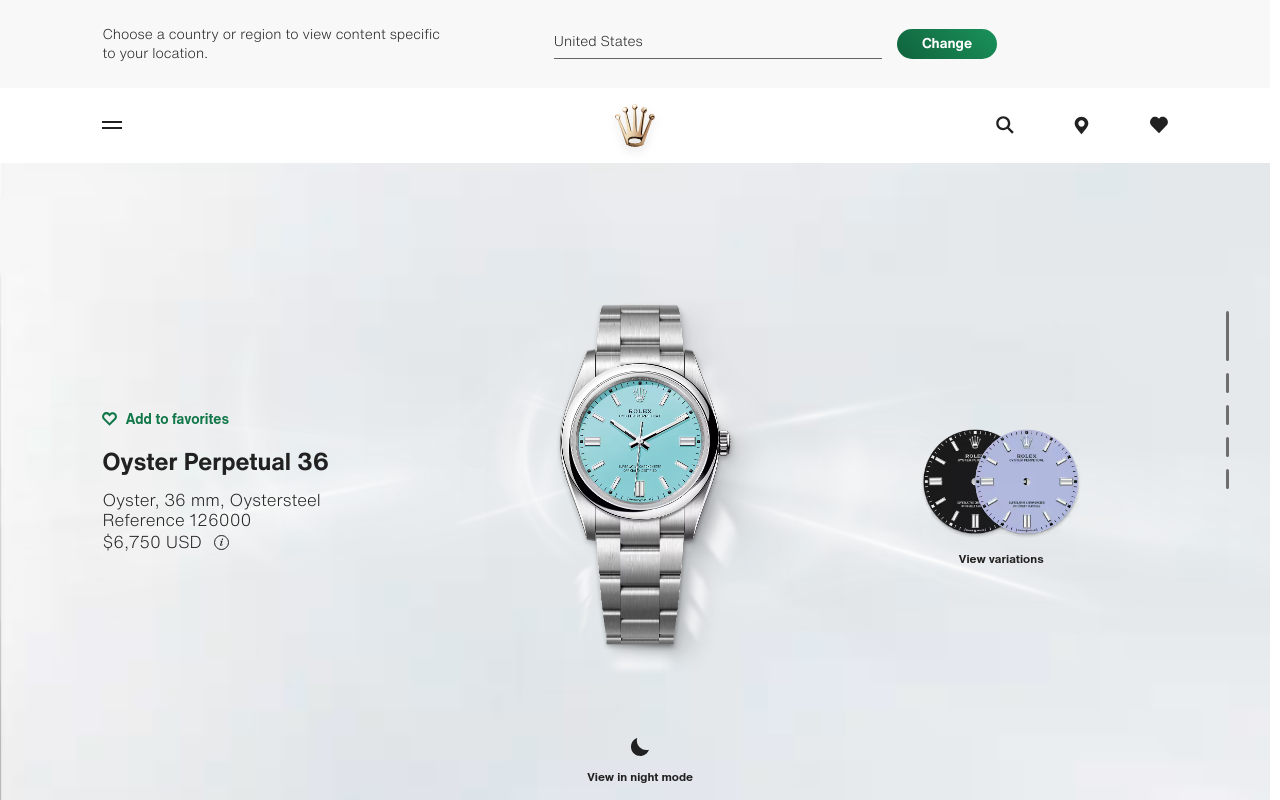
Rolex Oyster Perpetual 36, ref. 126000 (rolex.com US)
Source: https://www.rolex.com/en-us/watches/oyster-perpetual/m126000-0006
Product 1: Rolex Oyster Perpetual 36, ref. 126000. The maker's own page, captured as a buyer would see it.
OFFICIAL (rolex.com US, captured today) - Price: $6,750 USD, the same across the standard dials. The turquoise dial on this page is the one collectors chase; it trades very differently (see Independent). - Case: 36 mm Oystersteel, domed bezel, screw-down Twinlock crown, sapphire crystal. No date, so no Cyclops. - Water resistance: 100 m / 330 ft. - Movement: calibre 3230, self-winding, Superlative Chronometer at -2/+2 seconds a day after casing, about 70 hours of power reserve, Parachrom hairspring, Paraflex shock absorbers. Maker claims. - Bracelet: Oyster, three-piece solid links, folding Oysterclasp with the Easylink 5 mm comfort extension. - Guarantee: five years, through an Official Rolex Jeweler.
INDEPENDENT (dealers and reviewers, September 2026 snapshot) - Street price: standard dials (black, silver, blue) about $7,500 grey market, a modest premium over list; turquoise, coral, and Celebration dials $15,000 and up (Luxury Watches USA price guide, Sept 2026). The dial you choose moves the price more than anything else about this watch. - Availability at list: the easiest current Rolex to actually buy. Standard dials reported at weeks to a few months through an authorized dealer, sometimes in the case; bright dials still carry long waits (Luxury Bazaar waitlist survey 2026; Mio Jewelry 2026). Dealers allocate; there is no numbered list. - On the wrist: about 11.5 mm thick, about 43.5 mm lug to lug (Bob's Watches specifications). In a dark dial, about as anonymous as a luxury watch gets (WatchUSeek owner thread). - Service: Rolex recommends roughly every 10 years; a three-hand service runs about $800 to $1,000 (Bob's Watches service guide 2026). - Resale: standard dials roughly hold their value; bright dials have gained. From grey-market listings, not a maker claim. - Reviewer consensus: the recommended first Rolex for someone who wants minimalism and does not need a date (The Watchology; Watch Chest, 2026).
WHO IT'S FOR. Someone who wants a Rolex at Rolex's own price, would rather wait weeks than pay a grey-market premium, does not look at their wrist for the date, and prefers the watch nobody notices. The catch is the dial: pick a bright one and both the price advantage and the availability advantage disappear.
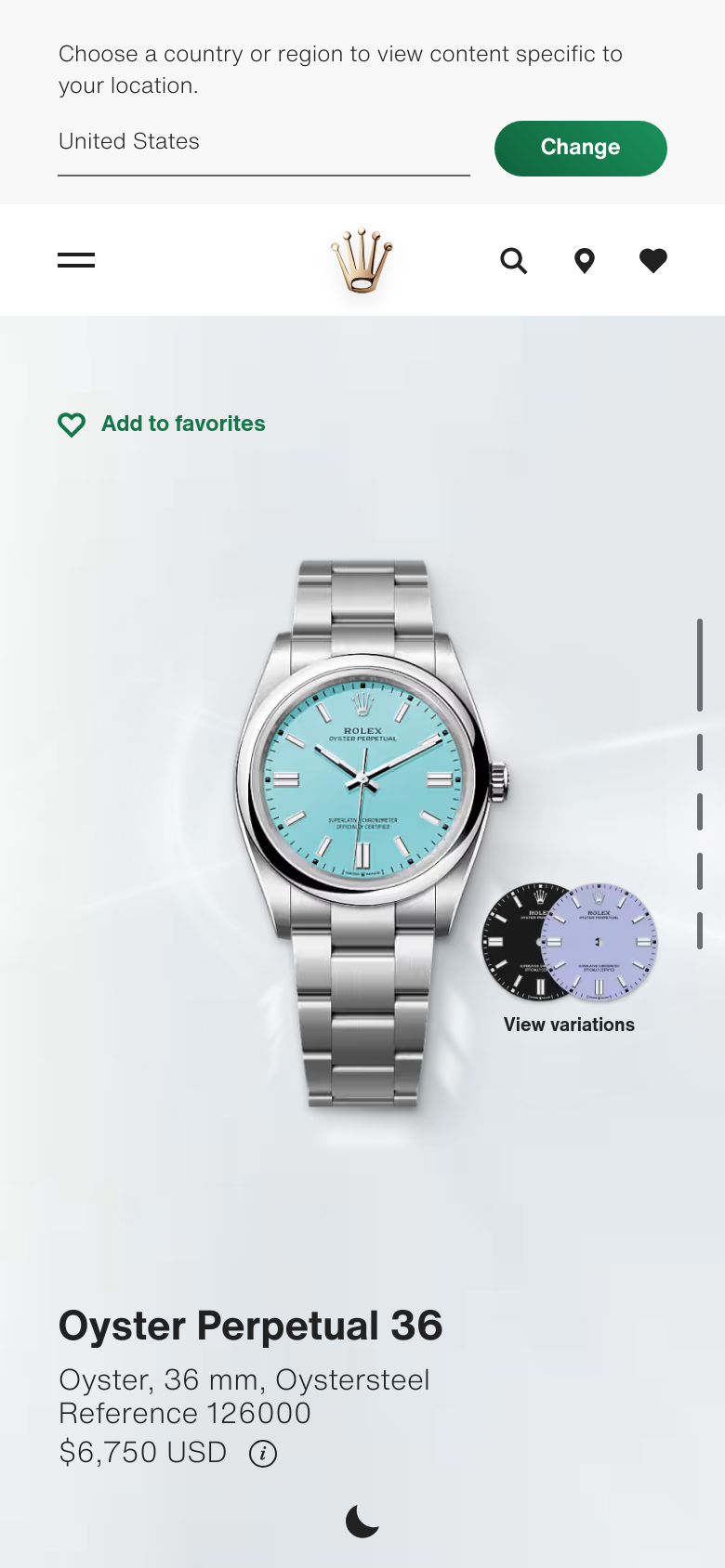
Rolex Oyster Perpetual 36, phone fold
 Source: https://www.rolex.com/en-us/watches/oyster-perpetual/m126000-0006
Phone fold of the same page. The model name, reference, and $6,750 price survive the fold; the dial variations and full specifications sit below it. The full analysis is on the desktop capture above.
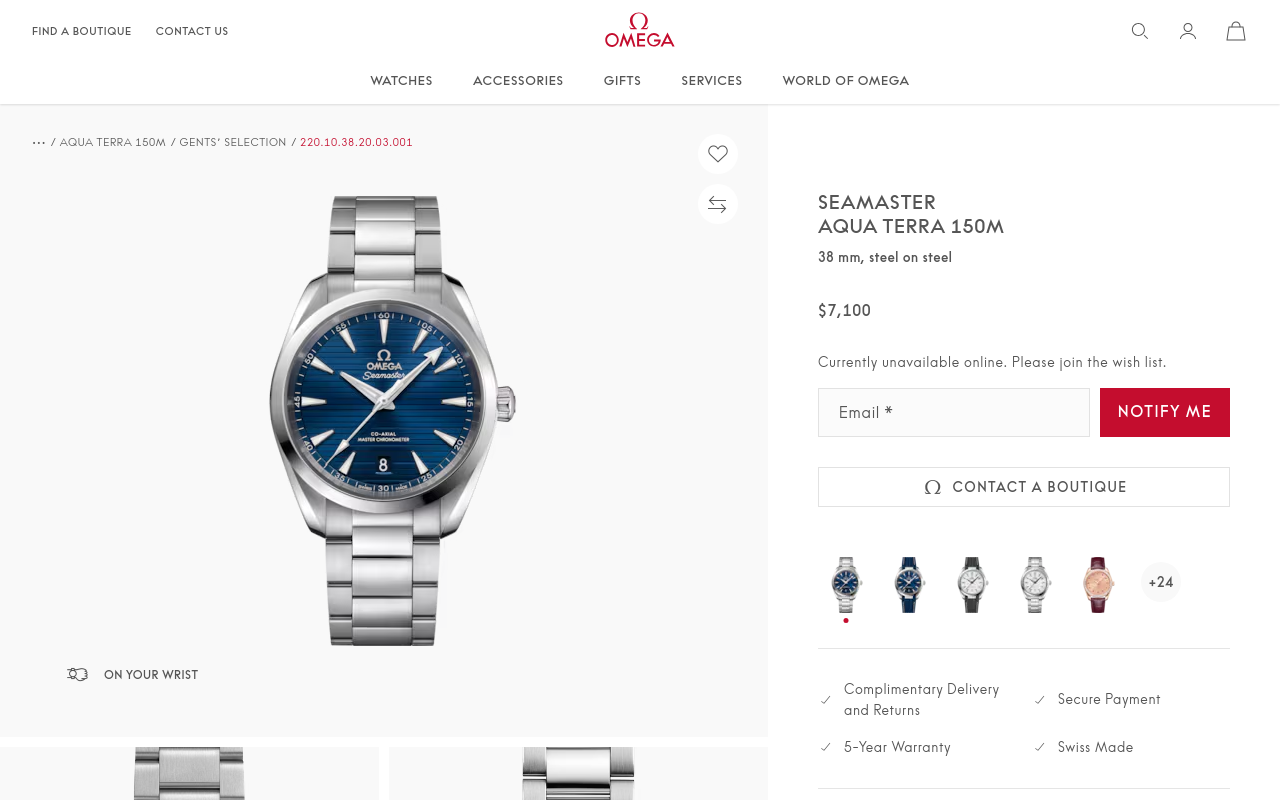
Omega Seamaster Aqua Terra 150M 38 mm, ref. 220.10.38.20.03.001 (omegawatches.com US)
Product 2: Omega Seamaster Aqua Terra 150M Co-Axial Master Chronometer 38 mm, ref. 220.10.38.20.03.001, blue dial on steel. The maker's own page, captured as a buyer would see it.
OFFICIAL (omegawatches.com US, captured today) - Price: $7,100 USD. - Stock: the page's own availability line is in the capture above, with "Contact a boutique" offered alongside it. Boutiques and authorized dealers are the normal route for this watch. - Case: 38 mm stainless steel, 45.0 mm lug to lug, 12.24 mm thick, screw-in crown, domed sapphire crystal with anti-reflective treatment on both sides, transparent caseback. - Water resistance: 15 bar / 150 m / 500 ft. - Movement: calibre 8800, Co-Axial escapement, Master Chronometer certified by METAS at 0/+5 seconds a day tested after casing, 55-hour power reserve, resistant to magnetic fields of 15,000 gauss. Maker claims, METAS certification independent. - Bracelet: brushed and polished steel with a butterfly clasp. No on-the-fly extension. - Warranty: five years. Complimentary delivery and returns when bought from Omega direct.
INDEPENDENT (dealers and reviewers, September 2026 snapshot) - Street price: new examples listed at about $5,900 to $6,400 at grey-market dealers, below the $7,100 list, and authorized dealers commonly negotiate on Omega (WatchMaxx and Chrono24 listings, Sept 2026). - Availability: in stock across dealers, no allocation. You can buy one this week. - Service: Omega recommends every 5 to 8 years; a three-hand Seamaster service runs about $650 to $800, with faster turnaround than Rolex (Watchscanning and Majestix Omega service guides, 2026). - Resale: expect to sell well under what you paid. The Aqua Terra loses a meaningful share of its value on the secondary market. From listings, not a maker claim. - On the wrist: the 45 mm lug to lug means the 38 wears close to a 36 mm Rolex despite the larger number (Fratello hands-on). - Reviewer consensus: WatchGecko calls it "the Datejust killer" and picks it on value, availability, the visible movement, and quieter branding; Monochrome gives Omega the movement and value rounds and Rolex the bracelet round (WatchGecko review; Monochrome verdict, 2026). - Accuracy in practice: METAS tests the cased watch in eight positions under a magnetic field; Rolex's standard is also post-casing with a tighter window on paper. Owners of both report similar real-world results. Treat as a tie.
WHO IT'S FOR. Someone who wants the best watch for the money, wants it this week at or below list, likes a sportier look with a date and a movement they can see through the caseback, and is not buying with resale in mind.
What I could not verify, and sources
Not verified - Live market price charts. WatchCharts and Chrono24 block automated readers, so every market figure above is from individual dealer listings and dated third-party summaries: a September 2026 snapshot with a range, not a quote. - Wait times at Rolex dealers. Rolex publishes nothing; the figures are buyer surveys and dealer blogs, and a given dealer's allocation may differ in either direction. - Discount depth at Omega authorized dealers. Reported as common by multiple sources, not quantified by any I would cite. - Omega online restock. The blue 38 read "Currently unavailable online. Please join the wish list." at capture; boutiques and authorized dealers stock it, but online direct availability was not confirmed. - Wrist fit. Every size comment assumes a typical 6.5 to 7.25 inch wrist. This is a try-on question no review settles.
Official (captured 5 September 2026) - Rolex Oyster Perpetual 36, ref. 126000, rolex.com US: price and technical details - The Rolex Guarantee, rolex.com: five-year guarantee terms - Omega Seamaster Aqua Terra 150M 38 mm, ref. 220.10.38.20.03.001, omegawatches.com US: price, availability line, dimensions, movement, warranty
Market and availability (September 2026) - Bob's Watches, Oyster Perpetual 36 listings and specifications - Luxury Watches USA, ref. 126000 price guide: standard versus bright dial pricing - WatchMaxx, Aqua Terra 38 listing - Chrono24, Aqua Terra 38 listing - Luxury Bazaar, Rolex waitlist survey 2026 - Chrono24 Magazine, Rolex waiting lists - Mio Jewelry, Rolex waitlists in 2026
Service costs - Bob's Watches, Rolex service cost guide 2026 - Watchscanning, Omega service cost 2026 - Majestix, Omega service cost
Independent reviews and owner discussion - WatchGecko, Aqua Terra 38 review, "the Datejust killer" - Monochrome, Aqua Terra versus Datejust, the verdict: movement and value rounds to Omega, bracelet round to Rolex - Fratello, hands-on with the Aqua Terra 38 - The Watchology, Datejust versus Oyster Perpetual 2026 - Watch Chest, Oyster Perpetual versus Datejust - WatchUSeek, Oyster Perpetual 36 owner thread
Company - Both makers are long-established and stable; no status research was needed for these products.
Made with Cobalt Capture.
Open the live review for the export buttons (markdown, PDF, Word) and the share card.
Run this on your product
Connect the Cobalt server once, then ask for a comparison study of your own site. Replace the placeholder URL with yours.
-
Claude Code
/mcp__cobalt__comparison_study "Product A vs Product B" -
Codex
Run: curl -s https://cobaltcapture.com/playbooks/comparison-study.md Then follow it exactly for Product A vs Product B -
Cursor, VS Code, Claude chat, Perplexity
Compare Product A and Product B for me, with a Cobalt review
Claude Code runs it as a slash command once the server is connected. Codex has no slash commands: connect with codex mcp add cobalt --url https://cobaltcapture.com/mcp, then paste the two lines. Cursor and VS Code connect with the button above, then take the sentence. In Claude chat or Perplexity, add https://cobaltcapture.com/mcp as a connector and ask in plain words; this study reads public pages, so it runs in full there. What this study checks.
Connect your agent to Cobalt
Cursor and VS Code install in one click. Claude Code and Codex copy a command to run in your terminal, then restart the app.
Two very good watches at almost the same list price, and the spec sheets will not choose between them. What does is what you would actually pay this month, whether you can walk out with one, whether you want a date on the wrist, and whether you will ever sell it. This page is the comparison study CobaltCapture ran cold against the makers' own pages, published in full; the live review carries the captures, every source, and the export buttons.
Critical differences, most consequential first
- What you pay and when you get it inverts the sticker prices. Retail says the Rolex is $350 cheaper. This month the Omega is the cheaper watch by $1,000 to $1,500 and it is in the case; the Rolex costs more than list to buy today, or list after a wait.
- Date or no date. Binary. Anyone who reads the date off their wrist has eliminated the Oyster Perpetual before any other row.
- Resale runs the other way. The one row where the Rolex wins clearly, and the one that reverses the lean for a buyer who might trade up.
- The bracelet on the wrist. The Rolex adjusts 5 mm with a fingernail when your wrist swells in summer; the Omega's butterfly clasp does not, and owners name it as the thing they would change.
- Movement character. A visible, anti-magnetic METAS movement against a sealed, longer-running Rolex calibre. Real, but a matter of what you value.
Where to start, if you are early
Answer three questions in order; each removes an option. Do you want the date on the wrist? Yes, and the Oyster Perpetual is out. Might you sell or trade up within a few years? Yes, and the Rolex's resale pulls it back in. Do you need it this week, or will you wait for a Rolex at list? Then try both on. All three questions are settled faster in a dealer's case than in any review.
Frequently asked questions
Is the Rolex Oyster Perpetual worth it?
As a first luxury watch, yes, on two conditions: you do not want a date on the wrist, and you buy a standard dial (black, silver, or blue) from an authorized dealer at the $6,750 list price after a wait of weeks to a few months. It is the simplest current Rolex, the most discreet of the two, it roughly holds its value, and its Oyster bracelet adjusts 5 mm on the fly. It stops being worth it the moment you pay a grey-market premium for a bright dial: turquoise, coral, and Celebration dials trade at $15,000 and up and carry Submariner-length waits, which erases both of the watch's advantages over the Omega.
Is the Omega Aqua Terra worth it?
For most first-time buyers, yes, and on the evidence it is the better value this month. New examples sell for about $5,900 to $6,400, below the $7,100 list, and authorized dealers commonly negotiate. It is in stock, it has a date, its METAS-certified calibre 8800 is anti-magnetic to 15,000 gauss and visible through the caseback, and it is rated to 150 m. The honest cost is resale: expect to sell well under what you paid, where the Rolex roughly holds. If you are buying to keep, that does not matter; if you might trade up, it does.
Is Omega as good as Rolex?
On the things a spec sheet measures, yes, and on some of them Omega is ahead: the Aqua Terra's movement is certified under a stricter magnetic-field test, offers higher water resistance, and can be seen through the caseback. Rolex is ahead on the bracelet clasp, the power reserve (70 hours against 55), the thinner case, and resale value. Finishing and real-world accuracy do not separate them. What separates them is price and availability in the real market, and brand signalling, none of which is about how good the watch is.
Does Omega hold its value like Rolex?
No. This is the clearest difference in the comparison and the row that most often reverses the decision. A standard-dial Oyster Perpetual 36 sells on the secondary market at or slightly above its $6,750 list, and the bright dials have gained. A new Aqua Terra 38 lists at $7,100 and sells new at about $5,900 to $6,400, so a used one sells for meaningfully less than a buyer paid. If you plan to keep the watch for decades, the difference is academic; if you might sell or trade up in a few years, it favours the Rolex.
Rolex vs Omega: which should a first-time buyer choose?
For the default first-time buyer, the Omega Aqua Terra 38, clearly, at about 60 to 40 on the criteria and weights the study used: it costs less today, you can buy it this week, and it has a date. Choose the Rolex Oyster Perpetual 36 instead if you expect to sell or trade up (resale), or if you do not want a date and are willing to wait weeks for a dealer to sell you one at list. Then go and try both on: the 36 mm and 38 mm cases wear closer than the numbers suggest, and the bracelet clasp is the thing no review settles for your wrist.
How was this run?
With CobaltCapture's comparison study, run from an AI agent against the makers' public pages. Nine criteria were weighted for a first everyday luxury watch and shown for approval before the run. Each maker's US product page was captured (the Rolex on desktop and phone, the Omega on desktop) as the receipt for prices and stock lines. Independent figures came from dealer listings, review sites, and owner forums, each dated and linked in the review. No account was created, nothing was purchased, and neither watch was handled. The live market price indexes block automated readers, so market prices are a September 2026 snapshot from individual listings, shown as ranges.
Run your first study.
Give your AI assistant a URL and walk away. Come back to a shareable review with real screenshots and the verdict on top.
Run a study