
Netflix pricing, explained: what you actually pay, and why the page will not tell you
Netflix costs $8.99 a month with advertising, $19.99 to remove the advertising, and $26.99 for 4K or more than two people watching at once, plus $7.99 or $9.99 a month for anyone outside your household. Read on September 5, 2026, from Netflix's own pages. The finding that drove this study is that none of those numbers appear on the page a subscriber walks through: /signup/planform is headed Choose your plan, contains no plans and no prices, and tells the visitor about endless entertainment for one low price. The only number on the buyer's path is Starts at $8.99, which is the ad tier.
Pricing teardown
Netflix does not have a pricing page. The page headed Choose your plan shows no plans and no prices, the only advertised number is the ad tier at less than half the ad-free price, and the full price list lives on a help-center support article.
What a buyer pays, as of Sep 5, 2026
| Buyer | Plan the page steers them to | Per month | Per year |
|---|---|---|---|
| One person, no ads | Standard | $19.99 | $239.88 |
| Household of four watching at once | Premium (Standard caps at 2 streams) | $26.99 | $323.88 |
| Household plus one person elsewhere, no ads | Standard + 1 extra member | $29.98 | $359.76 |
What the study found
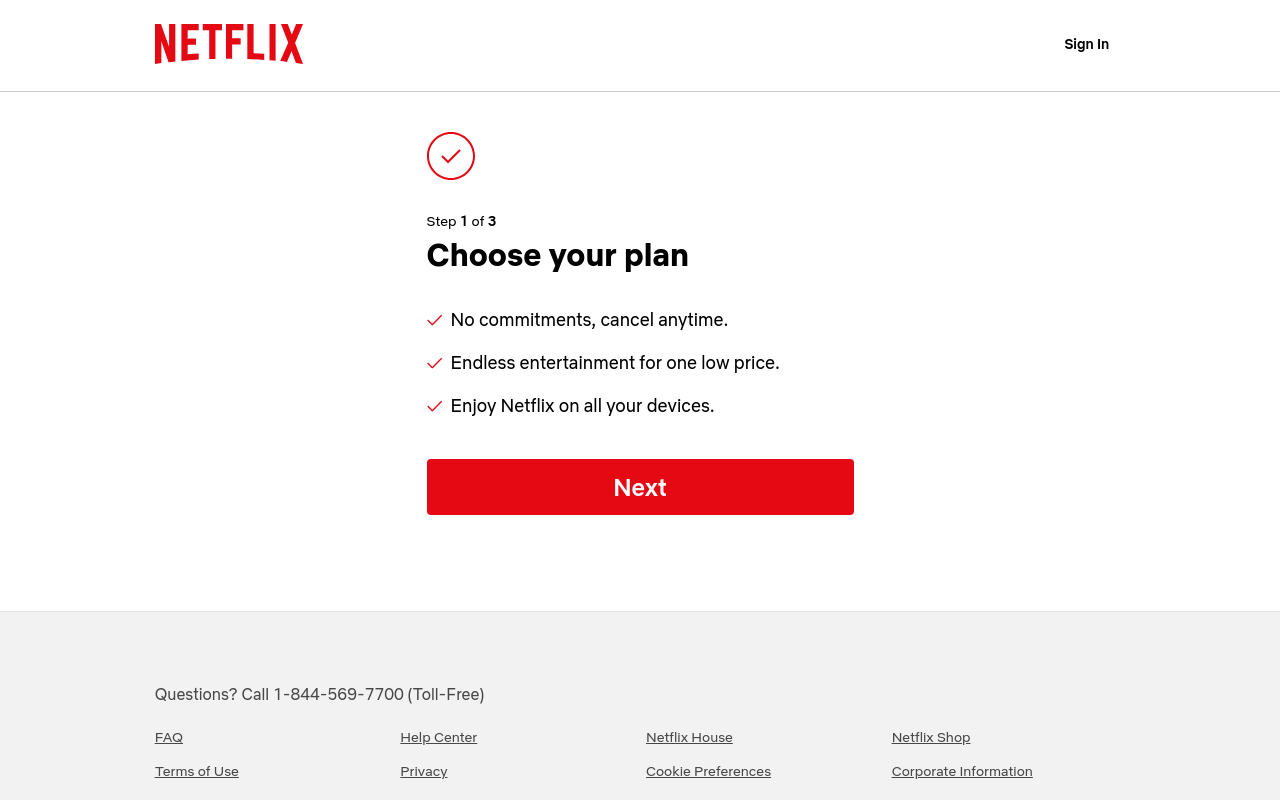
- The plan step shows no plan and no price, and claims a low price anyway. /signup/planform is headed Choose your plan and offers three reassurance bullets and a Next button, one of which reads Endless entertainment for one low price. A visitor cannot say what plans exist, which is theirs, or what it costs, and must enter an email and continue into account creation before a grid appears.
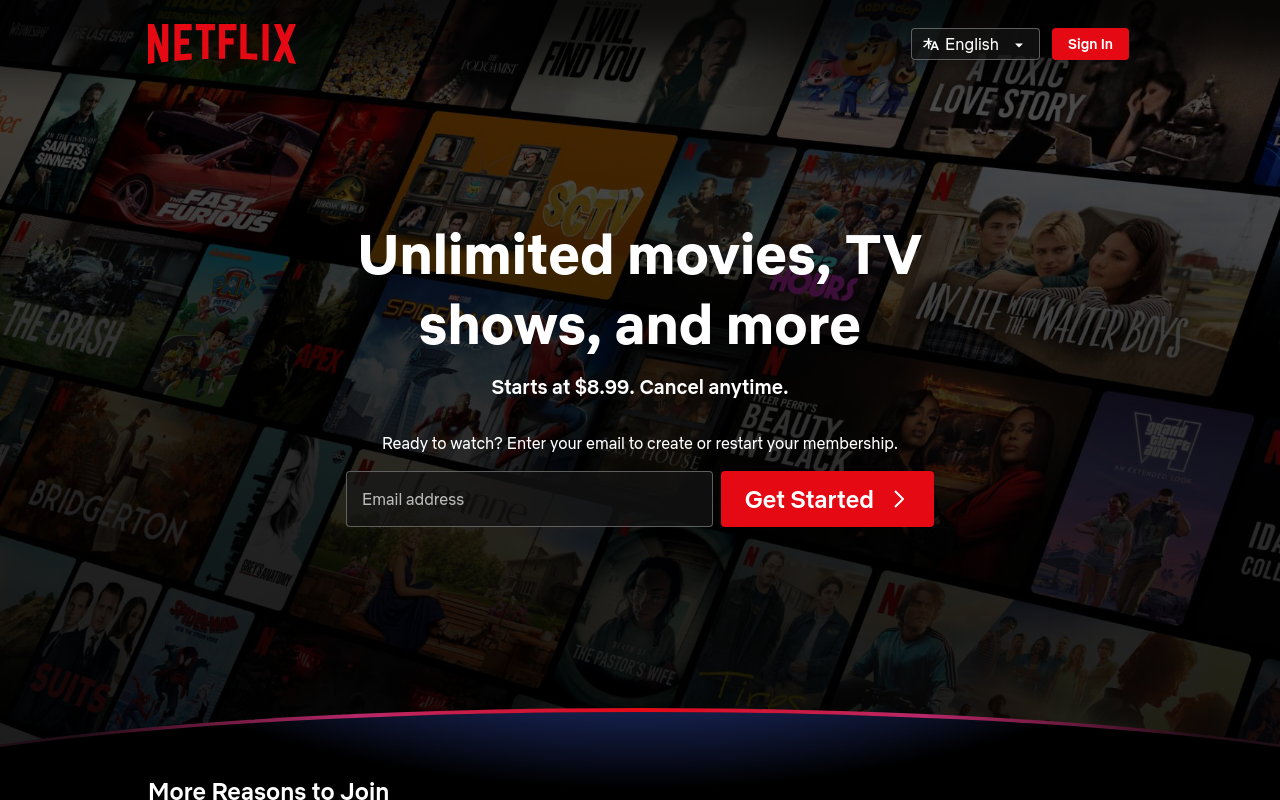
- The only advertised price is the ad tier, and it is less than half the ad-free entry price. The homepage reads Starts at $8.99. The plan that removes ads is $19.99. A buyer who assumes $8.99 is the price of Netflix is wrong by $11 a month and $132 a year.
- The $11 gap between the two Standard plans buys the removal of ads and nothing else. Standard with ads and Standard are identical on every feature Netflix lists: 2 streams, 1080p, 2 download devices. The buyer's rational response is to assume they have missed a feature and go looking for it.
- The extra-member slot costs more than an entire separate account. An ad-free extra member is $9.99 a month; a complete Standard with ads subscription is $8.99. The feature built for households that stretch across addresses is priced above the alternative it exists to prevent.
- The stream count, the thing that actually decides the tier for a family, never appears on the buyer's path. Standard allows two simultaneous streams, so a household of four needs Premium at $26.99. That limit appears only in the help-center article.
- Standard at $19.99 is 1080p only. The tier that reads as the normal choice for a normal household will not fill a 4K television, and reaching 4K means Premium at $26.99, a further 35 percent.
Read the full study
Netflix pricing teardown
Published 2026-09-06 via Cobalt Capture.
Reviewing: https://www.netflix.com/signup/planform
Summary
The finding in one line: Netflix does not have a pricing page. The page whose own heading is "Choose your plan" contains no plans and no prices. The only number on the buyer's path is "Starts at $8.99" in the homepage subhead, and that is the ad-supported plan. Ad-free actually starts at $19.99, which is 2.2x the number the visitor was shown. The complete price list lives on one public page: a help-center support article.
Run cold against the public pages on 5 September 2026, US. No account, no signup, nothing submitted. Prices quoted as printed.
The price story the pages actually transmit
In the buyer's words: "It starts at $8.99, I cancel any time, and I enter my email to find out the rest."
What is true: it is $8.99 with advertising, $19.99 to remove the advertising and nothing else, $26.99 if you want 4K or more than two people watching, plus $7.99 or $9.99 a month per person who does not live with you, plus tax.
The buyer math
| Buyer | Plan the page steers them to | Per month | Per year |
|---|---|---|---|
| One person, no ads | Standard | $19.99 | $239.88 |
| Household of four watching at once | Premium (Standard caps at 2 streams) | $26.99 | $323.88 |
| Household plus one person elsewhere, no ads | Standard + 1 extra member | $29.98 | $359.76 |
Every one of these is reachable only from the support article. None is reachable from the pages a buyer walks through, because those pages carry one price and it is the lowest one.
Findings, worst first
MISLEADS
1. The plan step shows no plan and no price, and says "one low price" anyway. /signup/planform, desktop and phone, is headed "Choose your plan" and offers three reassurance bullets and a Next button. One bullet reads "Endless entertainment for one low price," on a page containing no price. A visitor cannot answer what plans exist, which is theirs, or what it costs, and must enter an email and continue into account creation before the grid appears. Direction: show the three plans and their prices at this step, before the email.
2. The only advertised price is the ad tier, and it is less than half the ad-free entry price. The homepage reads "Starts at $8.99. Cancel anytime." The plan that removes ads is $19.99. A buyer who assumes $8.99 is the price of Netflix is wrong by $11 a month and $132 a year. Direction: say what $8.99 buys in the same sentence that claims it.
3. The $11 gap between the two Standard plans buys the removal of ads and nothing else. Standard with ads and Standard are identical on every feature Netflix itself lists: 2 streams, 1080p, 2 download devices. Charging for ad removal is legitimate; presenting two differently priced plans with no stated difference is not. The buyer's rational response is to assume they have missed a feature and go looking. Direction: label the ad-free step as what it is, priced on its own terms.
4. The extra-member slot costs more than an entire separate account. An ad-free extra member is $9.99 a month. A complete Standard with ads subscription is $8.99. The feature Netflix built for households that stretch across addresses is priced above the alternative it is meant to prevent, and no page says so. Direction: price the slot below the cheapest standalone plan, or explain what the slot gives that a separate account does not.
STALLS
5. The stream count, the thing that actually decides the tier for a family, is never on the buyer's path. Standard allows two simultaneous streams. A household of four cannot use it. That limit appears only in the support article, so the buyer most likely to need the $26.99 plan has no way to learn it before subscribing to the wrong one.
6. Standard at $19.99 is 1080p only. The tier that reads as the normal choice for a normal household will not fill a 4K television. Reaching 4K means Premium at $26.99, a further 35%. Nothing on the path connects the television someone owns to the plan they need.
7. There is no comparison table anywhere a buyer walks through. The support article lists features per plan in prose blocks; the differencing is left to the reader, across three separate lists.
FRICTION
8. Tax is disclosed only in the support article ("Depending on where you live, you may be charged taxes in addition to your membership price"), so no price the buyer sees on the path is the price they will pay.
9. The public price list is a support article. help.netflix.com/en/node/24926 is reachable through the footer Help Center, not from signup. It is also the page that ranks: this is where a search for Netflix pricing lands, which means Netflix's real pricing page is one it did not design as one.
Keep list, the do-not-regress half
- "No commitments, cancel anytime" is on the homepage and repeated at the plan step. It is the single most load-bearing reassurance in a subscription purchase and it is prominent in both places.
- The household rule is stated plainly in the support article: "A Netflix account is for people who live together in a single household." No euphemism.
- A toll-free human number sits in the signup footer. Rare, and worth keeping.
- The plan step is identical on phone and desktop. No collapse, no reordering, no lost controls.
- The price ladder itself is legible once you find it. Three plans, one axis each: ads, then streams and resolution. The structure is sound. The problem is entirely in what the buyer is shown and when.
Scope and method
Public pages only, rendered and captured on 5 September 2026: /signup/planform at desktop and phone, netflix.com/us at desktop, and the help-center price list. Prices read from the help-center article's own text. Not covered: the plan grid that appears after email entry and account creation, which is behind signup and out of scope for a read-only run. That grid may well answer several findings above, which does not change the finding: it is behind an email and an account, and the pages before it are not.
Netflix plan chooser, desktop, the page a subscriber actually lands on
Source: https://www.netflix.com/signup/planform
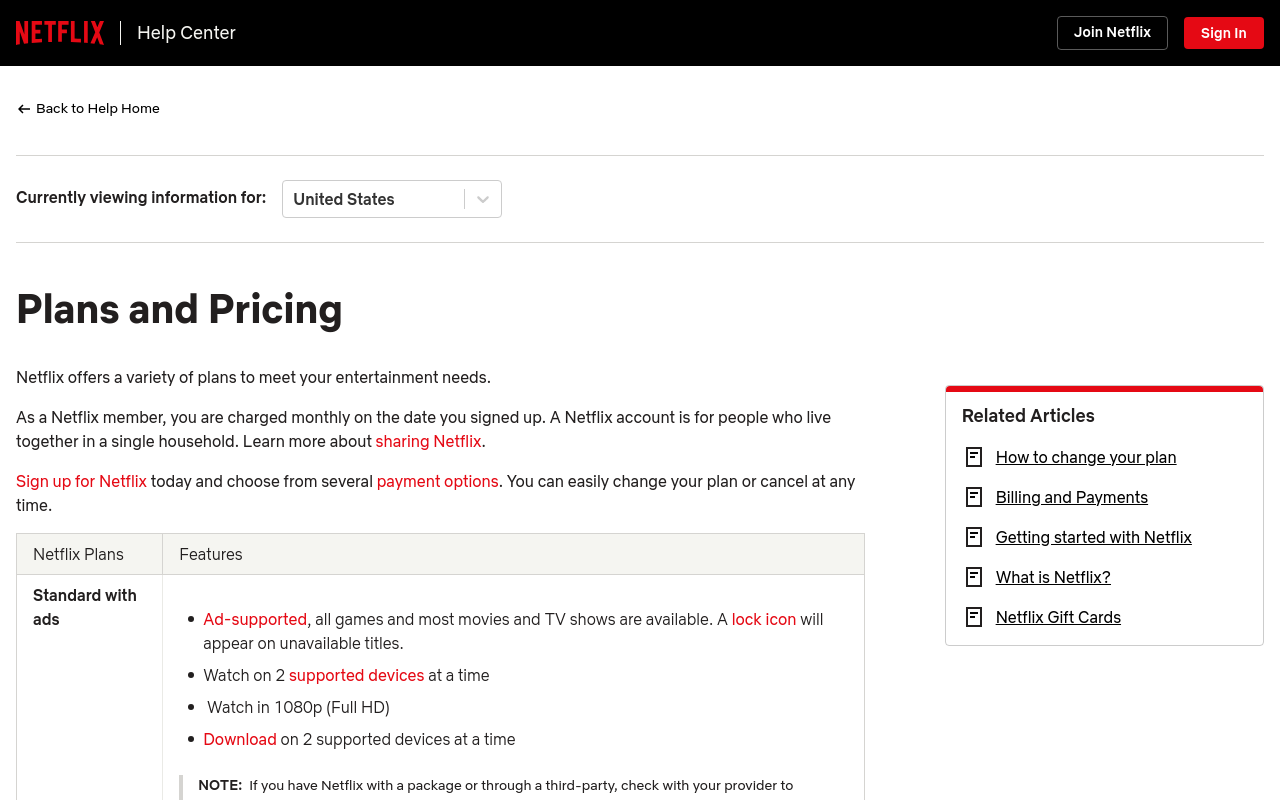
The only public page carrying Netflix's US prices is a help-center article
 Source: https://help.netflix.com/en/node/24926
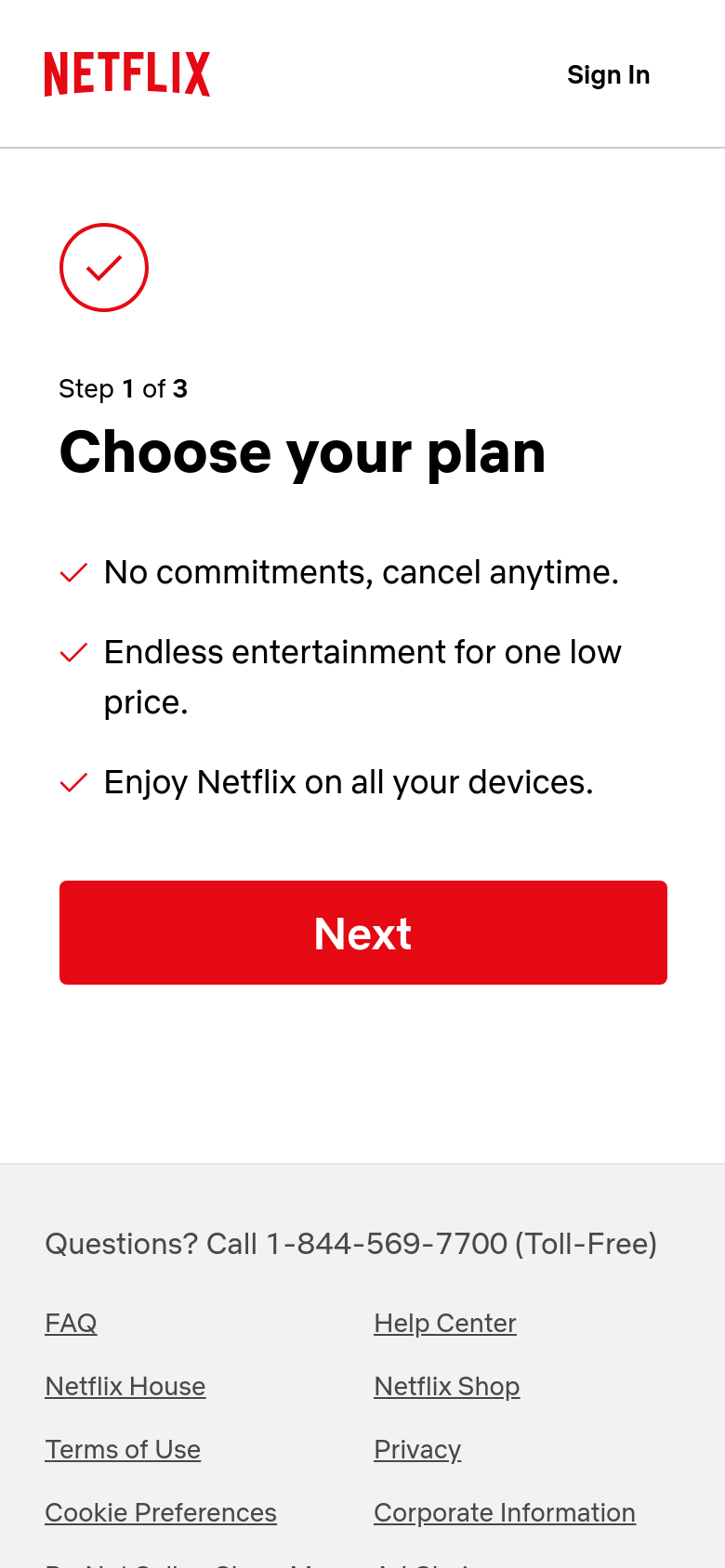
The same plan chooser on a phone: still no plan, still no price
 Source: https://www.netflix.com/signup/planform
Where the buyer starts: the US homepage, the entry to the signup flow
Source: https://www.netflix.com/us/
Pass A: the five-second fold
The test is what a visitor can answer from the fold alone, before scrolling, on the page they land on to subscribe.
Desktop, /signup/planform, the page whose own heading is "Choose your plan":
- How many plans are there, and what are they called? Cannot answer. The page names no plan.
- Which one is for someone like me? Cannot answer. There is nothing to choose between.
- What does it cost? Cannot answer. The page shows no number at all.
What it shows instead is "Step 1 of 3", three reassurance bullets, and a Next button. One of those bullets reads "Endless entertainment for one low price." That sentence appears on a page that does not contain a price.
Phone: identical. Same three bullets, same Next, no plan, no number.
The homepage, which is where the buyer actually starts: one number, in the subhead. "Starts at $8.99. Cancel anytime." Below it an email field and Get Started.
So the complete public price disclosure on the buyer's own path is the four characters $8.99, and that number belongs to the ad-supported plan. To see the plan grid a visitor enters an email address and continues into account creation. The full price list exists on exactly one public page, and it is a help-center support article at help.netflix.com/en/node/24926, reachable from the footer under Help Center, not from the signup path.
This is the finding the rest of the teardown hangs off. Netflix does not have a pricing page. It has a price in a marketing subhead and a support article, with an account-creation flow in between.
Pass B: the buyer math
Prices as printed in the help-center article, captured 5 September 2026. Taxes are extra and stated only there: "Depending on where you live, you may be charged taxes in addition to your membership price."
| Plan | Price | Streams | Resolution | Downloads | Ads |
|---|---|---|---|---|---|
| Standard with ads | $8.99 / month | 2 | 1080p | 2 devices | Yes |
| Standard | $19.99 / month | 2 | 1080p | 2 devices | No |
| Premium | $26.99 / month | 4 | 4K + HDR | 6 devices | No |
Extra member slots: $7.99 each with ads, $9.99 each without. Standard allows one, Premium allows two.
Buyer 1, one person who does not want ads. The homepage told them $8.99. The plan that removes ads is $19.99. Monthly $19.99, annual $239.88, against the $107.88 they were anchored to. The gap between the advertised entry price and the price of the thing most people think they are buying is 2.2x.
Buyer 2, a household of four watching at the same time. Standard caps at two simultaneous streams, so four people need Premium. Monthly $26.99, annual $323.88. Nothing on the buyer's path connects "four of us" to "you need the $26.99 plan"; the stream count lives only in the support article.
Buyer 3, a household plus one person living elsewhere, no ads. Standard $19.99 plus one extra member at $9.99 equals $29.98 a month, annual $359.76. This is where the pricing model quietly switches: every other price on the page is per household, and this one is per person.
Pass C: the tier architecture, and the $11 that buys nothing
Line the three plans up on their own stated features and one thing is unmissable. Standard with ads and Standard are the same plan. Same two streams, same 1080p, same two download devices. The entire $11.00 a month difference, $132 a year, purchases the removal of advertising and nothing else.
That may well be the right price for removing ads. The problem is that no page on the buyer's path says that is what the money is for. A visitor looking at $8.99 and $19.99 with no feature difference between them will assume they have missed something, and hunt for the catch, and hunting for the catch is not a state you want a buyer in.
Two more structural notes:
- Standard at $19.99 is 1080p only. A buyer who has bought a 4K television and wants to use it must reach Premium at $26.99, a further 35% step. The tier that sounds like the normal one for a normal household is the one that will not fill their screen.
- The extra member slot is priced above a whole account. An ad-free extra member costs $9.99 a month. An entire separate Standard with ads subscription costs $8.99. The cheaper option for a household stretching to a second location is often to stop using the feature Netflix built for exactly that case, and Netflix has no reason to tell them so.
Passes D, E, F: fine print, trust, phone
There is no feature comparison table on any page a buyer walks through. The support article carries a features list, not a comparison, so the buyer performs the differencing themselves across three prose blocks.
Trust signals on the path are genuinely good and worth keeping: "No commitments, cancel anytime" appears on both the homepage and the plan step, a toll-free support number sits in the footer of the signup flow, and the household rule is stated plainly in the support article ("A Netflix account is for people who live together in a single household"). Working against that: the only price a visitor sees before handing over an email is the lowest one, and the tax line lives two clicks off the path.
On the phone the plan step is identical to desktop, which sounds like a pass and is not: it is identically empty. Nothing degrades because there is nothing to degrade.
Made with Cobalt Capture.
Open the live review for the export buttons (markdown, PDF, Word) and the share card.
Run this on your product
Connect the Cobalt server once, then ask for a pricing teardown of your own site. Replace the placeholder URL with yours.
-
Claude Code
/mcp__cobalt__pricing_teardown https://your-product.com -
Codex
Run: curl -s https://cobaltcapture.com/playbooks/pricing-teardown.md Then follow it exactly against https://your-product.com -
Cursor, VS Code, Claude chat, Perplexity
Run a pricing teardown of https://your-product.com
Claude Code runs it as a slash command once the server is connected. Codex has no slash commands: connect with codex mcp add cobalt --url https://cobaltcapture.com/mcp, then paste the two lines. Cursor and VS Code connect with the button above, then take the sentence. In Claude chat or Perplexity, add https://cobaltcapture.com/mcp as a connector and ask in plain words; this study reads public pages, so it runs in full there. What this study checks.
Connect your agent to Cobalt
Cursor and VS Code install in one click. Claude Code and Codex copy a command to run in your terminal, then restart the app.
Netflix is the largest pricing question on the internet, and the answer is harder to find than the question deserves. This page carries the pricing teardown run cold against Netflix's public pages, published in full with the captures.
The short version, for anyone who came here for a number: $8.99 with ads, $19.99 without, $26.99 for 4K or a household of four. Everything else on this page is about why you had to look it up.
Prices are what Netflix showed on the run date at the top of the section above. When Netflix changes them, the study is re-run and this page moves to the new review, with the old one kept as history.
Frequently asked questions
How much is Netflix a month?
As of September 5, 2026, in the United States: Standard with ads is $8.99 a month, Standard is $19.99 a month, and Premium is $26.99 a month. Extra member slots are $7.99 each a month with ads or $9.99 each without, with one allowed on Standard and two on Premium. Taxes are additional and Netflix states this only in its help-center article, so no advertised price is the price that will be charged.
What is the cheapest Netflix plan?
Standard with ads, at $8.99 a month. It carries advertising, allows two simultaneous streams, streams at 1080p, and allows downloads on two devices. It is also the number Netflix advertises on its homepage as Starts at $8.99, which is why many people believe Netflix costs about nine dollars. The cheapest plan without advertising is Standard at $19.99.
What is the difference between Netflix Standard with ads and Standard?
On Netflix's own published features, nothing except the advertising. Both allow two simultaneous streams, both stream at 1080p, and both allow downloads on two devices. The $11.00 a month difference, $132 a year, buys ad removal alone. That may be a fair price for removing ads, but no page on the signup path says that is what the money is for, so buyers reasonably assume they have missed a feature.
Do I need Netflix Premium?
Only for two reasons, and both are ones the signup flow never mentions. Premium at $26.99 is the only plan that allows four simultaneous streams, so a household where more than two people watch at the same time needs it. It is also the only plan with 4K and HDR, so anyone using a 4K television needs it to fill the screen. Standard at $19.99 caps at two streams and 1080p.
Is Netflix worth it?
This study judged the pricing pages, not the programming, so it cannot answer that for you. What it can tell you is that the decision is usually made on the wrong number. People weigh Netflix against $8.99, the figure on the homepage, when the ad-free price is $19.99 and a family that watches simultaneously in 4K pays $26.99, which is $323.88 a year before tax. Work out which plan your household actually needs first, because the price you are comparing against is probably not the price you would pay.
Where is Netflix's pricing page?
There is not one, in the ordinary sense. The complete US price list is published on a help-center support article at help.netflix.com, reachable through the footer Help Center rather than from the signup path. That article is also the page that ranks in search, which means Netflix's de facto pricing page is one it did not design as a pricing page.
How was this run?
With CobaltCapture's pricing teardown playbook, run by an AI agent against Netflix's public pages on September 5, 2026, with no account created, no card entered, and nothing submitted. Screenshots were rendered server-side at desktop and phone widths, and prices were read from Netflix's own help-center text. The plan grid that appears after email entry and account creation was not covered, because it sits behind signup and this study is read-only. That grid may answer several of the findings above, which does not change the finding: it is behind an email and an account, and the pages before it are not.
Run your first study.
Give your AI assistant a URL and walk away. Come back to a shareable review with real screenshots and the verdict on top.
Run a study